Multi-Location Med Spa Marketing: How to Grow Every Location Without Losing Your Brand
What changes when you go from one med spa to two, five, or ten. Google profiles and location pages, reviews, lead response, ads, reporting by location, and how to launch your next location with patients already booked.
A second location isn’t your first location twice. It’s a new business in a new neighborhood that happens to share your name. Centralize the things that protect your brand and your data: the CRM, lead response, review system, ad accounts, and reporting. Localize the things patients judge locally: a Google Business Profile and a page for every location, local reviews, local offers, and community ties.
Then track every location on the same few numbers, so you notice the one that’s slipping before your bank account does. Opening another one? Start marketing it 90 days out. It opens with zero reviews, and your flagship’s reputation won’t carry it in Google Maps.
1. Open every location’s Google profile on your phone and check the category, services, hours and booking link. Details
2. Count each location’s reviews from the last 90 days. The lowest number is your first fix. Details
3. Fill out your own website form for each location at 8 p.m. and time the reply. Details
4. Ask for last month’s report split by location. If nobody can produce it, that’s the real problem. Details
5. Decide who owns marketing: you, a central team, or each location. Details
Why marketing breaks at location two
At one location, you are the marketing system. You know which Instagram post brought in that wave of Botox consults. You remind the front desk to ask for reviews. You notice Tuesday afternoons are slow and run a quick promotion. None of that is written down, and it doesn’t need to be.
Then you open location two, and nobody is doing any of that over there. Here’s what typically goes wrong when a med spa group has just expanded:
- The second location’s Google listing was set up by whoever was free that week, with the wrong category and half the services missing.
- Location one has 400 reviews. Location two has 12, and the newest is four months old.
- One Google Ads campaign covers both locations, so nobody can say which one the leads actually booked at.
- The front desk at one location replies in two minutes. The other replies the next morning.
- The marketing report blends both locations together, so a strong location hides a struggling one.
You’re not alone in figuring this out the hard way. AmSpa’s 2024 State of the Industry report found 81% of med spas are still single-location businesses, which means most owners expanding have never run multiple locations before. The groups that do expand are getting bigger fast: multi-location operators averaged nine locations in 2024, up from six in 2022.
Location two isn’t a copy of location one. It’s a new business in a new neighborhood that happens to share your name.
None of this means you hired the wrong people. It means the habits that lived in your head never made it to the second building. Everything below is about writing those habits down and making them run without you, in the order I’d fix them.
What to centralize and what to keep local
The first decision is what should be identical at every location and what each location should own. Get it wrong in one direction and your brand fragments into five slightly different med spas. Get it wrong in the other and your location managers can’t react to their own market.
A quick way to decide: if getting it wrong at one location could hurt the whole brand, it’s central. If it only works because someone knows the neighborhood, it’s local.
| Centralize | Keep local |
|---|---|
| Brand standards, templates, and tone of voice | Photos of that location’s team and treatment rooms |
| One website on one domain | Each location’s page: team, parking, directions, local reviews |
| CRM, lead routing, and response-time standards | Google Business Profile posts, Q&A-style details, and hours |
| Review request system and response guidelines | Replies to reviews, signed by the location manager |
| Ad accounts, tracking, and conversion setup | Local offers and seasonal promotions, within brand rules |
| Reporting definitions and the monthly scorecard | Community events, partnerships, and local press |
| Compliance review of every marketing claim | Provider spotlights and local social content |
| Membership program and pricing rules | Referral relationships with nearby businesses |
Notice that nothing touching patient data, ad spend, or measurement is on the local side. Those are the things that quietly fall apart when every manager does it their own way.
Who should own marketing in your setup?
Before you fix a single listing, settle who makes the calls. Not all multi-location med spas are built the same way, and the right setup depends on who owns each location and who pays for the ads.
| Your setup | Who should own marketing | Watch out for |
|---|---|---|
| You own every location | One central person or partner owns accounts, budget and reporting. Location managers own reviews, photos and local events. | Managers quietly running their own boosted posts and promos |
| Partners or injectors own a stake in some locations | Shared systems run centrally, with an agreed split of ad spend and clear rules on which leads belong to which location. | Arguments over whose lead it was. Decide the routing rules in writing first. |
| Franchise or licensed locations | Brand, website and compliance stay central. Each owner runs local ads within brand rules, often from a shared marketing fund. | Owners building their own websites and Google profiles that don’t match the brand |
Whatever your setup, one rule doesn’t bend: the business owns every account. Ad accounts, Google profiles, the domain and the CRM should never sit in a former manager’s or agency’s personal login. Getting them back later can take weeks, and sometimes they’re gone for good.
Google: one profile and one page for every location
For most med spas, the Google Business Profile is the biggest source of calls. At multiple locations, you don’t have one listing to optimize. You have one per location, and each competes in its own neighborhood. A strong listing in one town does nothing for the map pack three towns over.
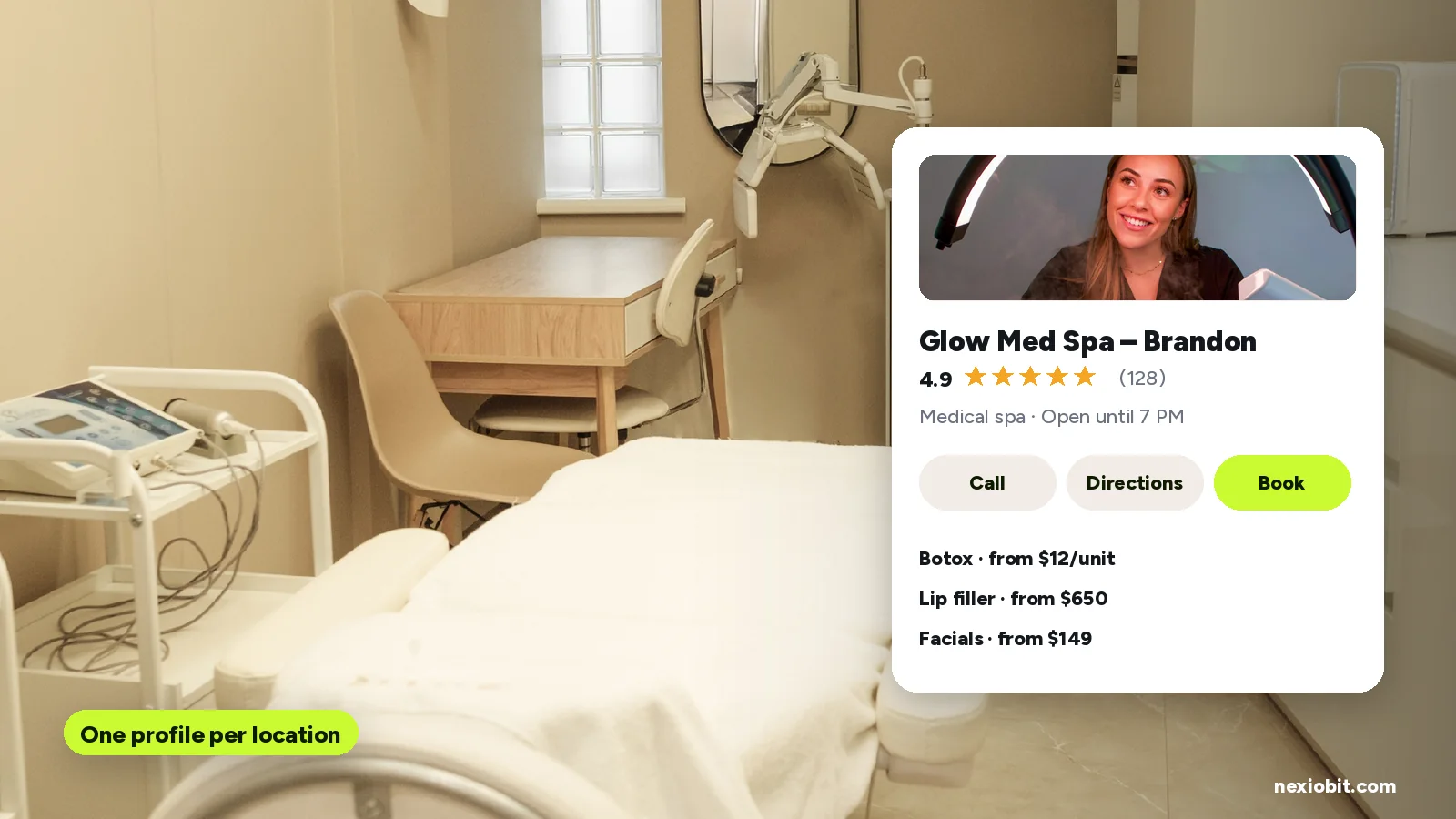
A Google Business Profile for each location
Every location that sees patients at a real address during posted hours gets its own profile. Then make sure each one is complete, not just claimed:
- Use the same brand name at every location, exactly as it appears on your signage. Don’t add city names or treatment keywords to the name. It breaks Google’s guidelines and can get a listing suspended.
- Set “Medical spa” as the primary category everywhere. It was the top-scored local ranking factor in Whitespark’s 2026 survey of local search experts.
- List only the services that location actually offers, with price ranges. If only one location has a laser, only that profile should list laser treatments.
- Give each location its own booking link that opens that location’s calendar, not a generic “choose a location” page.
- Tag every website link so you can see which listing sent the traffic, for example
?utm_source=gbp&utm_campaign=tampa. - Upload real photos from each location: the team, the rooms, the front of the building.
One Tampa med spa we manage got 580 calls from its Google listing in five months with no ad spend. That’s one location. Now picture every location in your group with a listing built to that standard.
A real page on your website for each location
Keep one website on one domain, with a page for each location, like yoursite.com/locations/tampa/. Separate websites for each location split your authority and multiply the work. Each location page should earn its place with content that’s actually unique:
- The providers who work there, with credentials
- Which treatments that location offers
- Address, parking, directions, and the landmarks people recognize
- Reviews from patients at that location
- A booking button that goes to that location’s calendar
- LocalBusiness or MedicalBusiness schema with that location’s details
Then link each Google profile to its own location page, not your homepage. A patient who tapped the Brandon listing wants Brandon’s hours, not your brand story.
Stop your locations from competing with each other
This one catches a lot of growing groups off guard. In the map pack, distance does most of the work, so nearby locations rarely steal from each other there. On your website, though, it’s easy to accidentally make your own pages compete.
The usual cause is copying a treatment page for every city: “Botox in Tampa,” “Botox in Brandon,” “Botox in St. Pete,” all with the same text and a different city name. Google sees near-duplicates and often ranks none of them well. A better setup:
- Keep one strong page per treatment, and list which locations offer it.
- Create a treatment page for a specific city only when there’s real search demand and you can write something genuinely local for it, like that location’s injector, pricing, and reviews.
- Check Search Console regularly. If two of your URLs keep showing up for the same search, they’re splitting the ranking. Our step-by-step med spa SEO guide covers how to spot and fix this.
Reviews at every location (not just your best one)
Patients don’t see your group’s total review count. They see the reviews for the location in front of them. And a weak location doesn’t just struggle on its own: BrightLocal found 91% of consumers say a single branch’s reviews affect how they see the wider brand.
That makes reviews a brand problem, not a location problem. A few things matter more at multiple locations:
- A new location starts at zero. BrightLocal’s 2026 survey found 47% of consumers won’t use a business with fewer than 20 reviews. Make 20 genuine reviews the first target for every new location, starting with your soft opening.
- Recency matters as much as volume. 74% of consumers only trust reviews from the last three months, so a location whose newest review is from spring looks closed.
- Each location needs its own review link so patients land on the right profile. A review on the wrong location helps nobody.
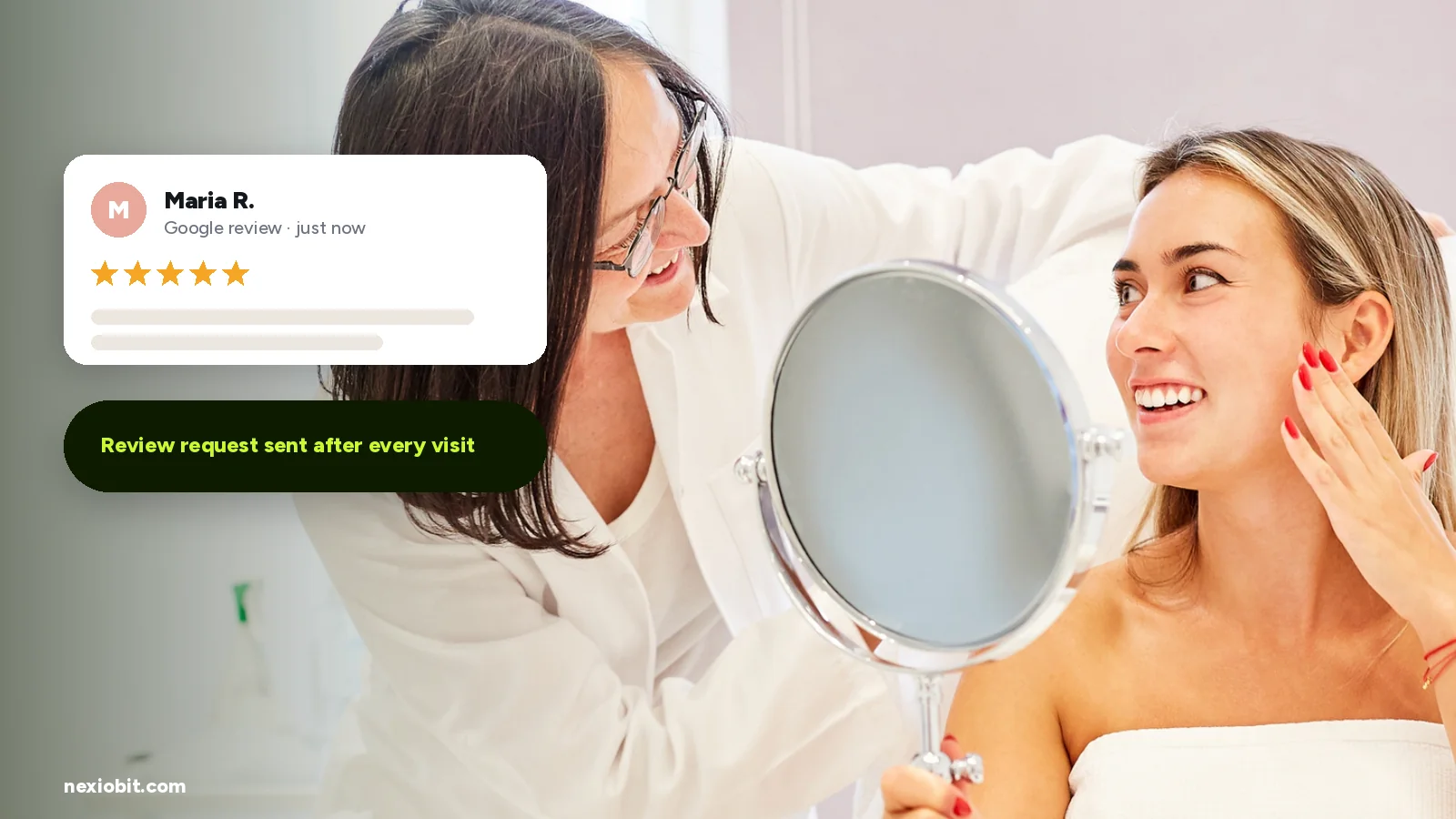
- Tie each request to the provider and location the patient visited. Have your CRM send it automatically after checkout, mentioning the provider by first name. Reviews that name a provider build trust in that person, and they help you see which providers patients rave about at each location.
- Ask every patient the same way. Send the same request to everyone after their visit, with an easy way to reach the team if something went wrong. Only asking happy patients is review gating, which Google’s policy prohibits.
- Reply from the location, signed by the manager, and never confirm someone was a patient or mention treatment details in a public reply. HIPAA applies to review responses.
Compare review velocity across locations every month. When one location’s new reviews dry up, it usually means the ask stopped happening there, and that’s a five-minute fix if you catch it early.
Answering every lead, at every location
Response time is where multi-location groups leak the most money, because every location handles it differently. The Lead Response Management study (MIT and InsideSales, 2007) found leads contacted within 5 minutes were 21 times more likely to qualify than leads contacted after 30 minutes. Multiply that gap across five front desks with five different habits.
There are three common ways to handle it:
| Approach | Works well when | Where it breaks |
|---|---|---|
| Each front desk handles its own leads | 2 locations with strong, stable managers | Busy days, sick days, evenings, and weekends |
| A central team answers for every location | 5+ locations with enough volume to staff it | Cost, and staff who don’t know each location |
| AI answers first, local staff take over | Almost any size, especially with after-hours leads | Only if the AI isn’t trained on each location’s menu and calendar |
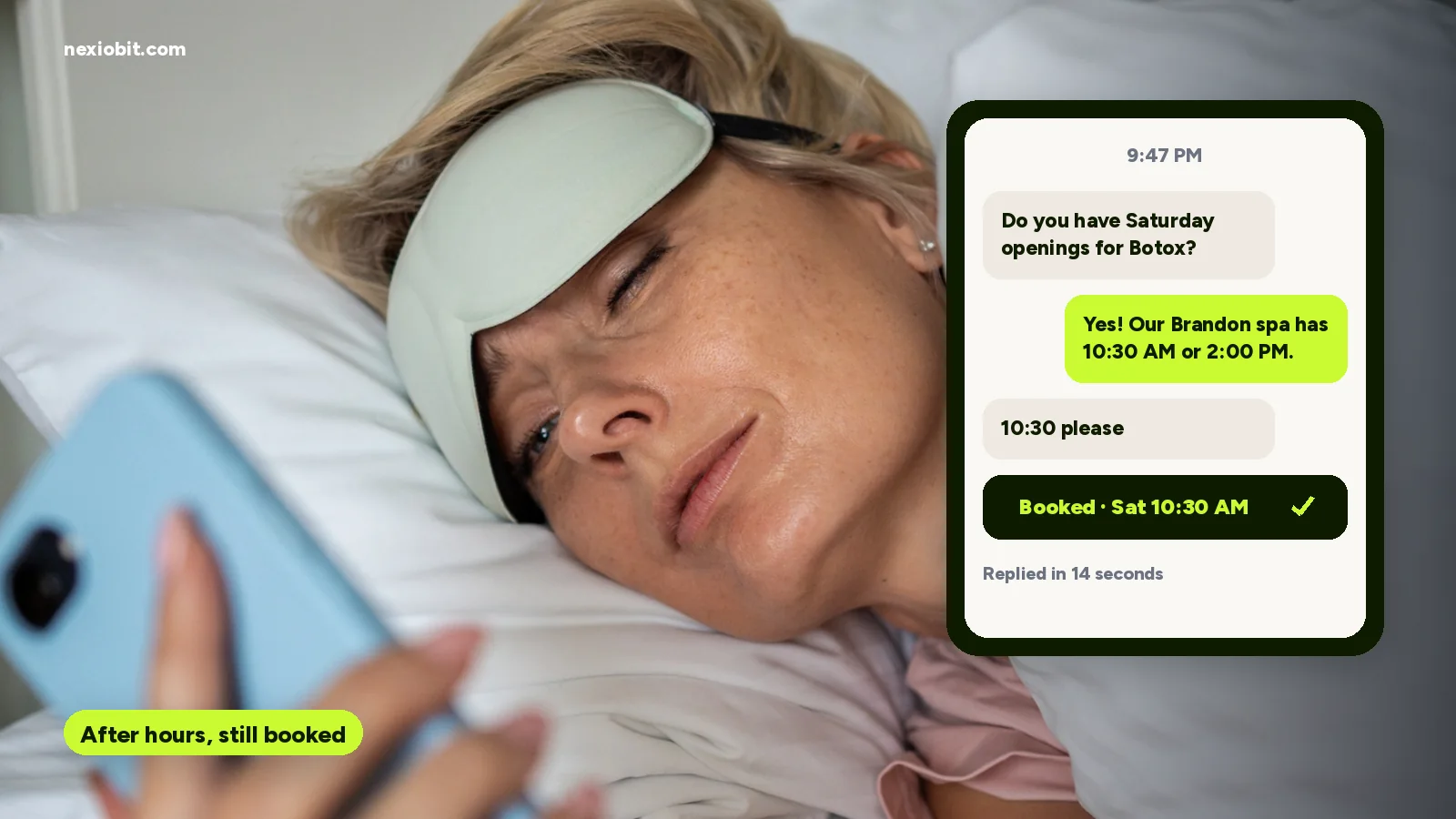
Most growing groups end up with the third option. An AI receptionist answers every call, chat, and form in seconds, knows which location the patient wants, books into that location’s calendar, and hands the conversation to that location’s team when a human is needed. Whatever you choose, set these up across every location:
- A separate, tracked phone number for each location
- Missed-call text-back on every line, so an unanswered call becomes a conversation
- One shared inbox for messages, tagged by location
- The same response-time standard everywhere, with an escalation if a lead sits too long
Here’s what fast, automated first responses look like at a single location: SoCal Slim in Riverside, California reached a 67.98% chat-to-booking rate and $32,940 in won revenue in 31 days with an AI receptionist, CRM and treatment campaigns working together. A group runs the same system once, then routes each lead to the right location.
This is getting more important, not less. At Google I/O in May 2026, Google said Search is expanding AI booking to local services, and that for categories like beauty it can call a business on a searcher’s behalf. A line that goes to voicemail loses that booking. See how NexioFront handles this, or compare options in our guide to AI receptionists for med spas.
Paid ads across locations
The most common ad mistake at multiple locations isn’t bad creative. It’s structure. When each location manager runs their own ads, or one campaign covers every location, you either bid against yourself or can’t see what’s working.
- Run one ad account per platform for the whole group, with one conversion setup. Separate accounts per location can end up competing for the same searches and drive your own costs up.
- Split brand and local campaigns. Brand campaigns (people searching your name, awareness video, brand creative) run centrally. Local campaigns run per location, with targeting areas that don’t overlap.
- Run one campaign per treatment at each location, each with its own budget. Botox, laser hair removal and medical weight loss attract different patients at different costs, and lumping them together hides which one is actually booking.
- Keep targeting tight around each clinic. Most patients won’t drive far for a 15-minute injectable appointment, so start with a small radius around each location and widen it only for high-value treatments people will travel for, like body contouring.
- Send each local ad to that location’s page and that location’s calendar, never to your homepage.
- Let budget follow capacity, not fairness. If one location has an injector booked three weeks out and another has open chairs every afternoon, shift spend to the location with room. Equal budgets feel fair and waste money.
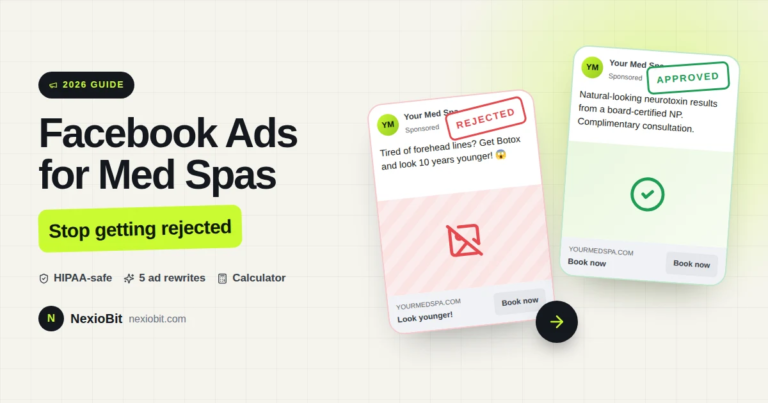
- Keep creative compliant everywhere. Meta restricts health and wellness targeting, and claims about compounded GLP-1 drugs have drawn repeated FDA warning letters. One non-compliant ad can put the whole account at risk.
For the details, see our Facebook ads playbook for med spas, our weight loss clinic marketing guide for GLP-1 rules, or how we run Google and Meta ads for med spas.
Reporting by location: the scorecard that catches problems early
If your marketing report shows one number for the whole group, it’s hiding things. A great location can mask a struggling one for months. The fix is a monthly scorecard with the same numbers for every location, side by side.
| Metric | Why it matters | What a gap between locations usually means |
|---|---|---|
| Leads by source | Shows where each location’s patients come from | One location relies on a single channel |
| Speed to first response | The biggest driver of bookings | A staffing or routing problem at that site |
| Booked consultations | Leads mean nothing until they book | Follow-up or consult offer needs work |
| Show rate | Booked patients who actually arrive | Reminders aren’t running at that location |
| Cost per booked consult | True marketing efficiency | Ad targeting or landing page issues |
| Rebook rate at checkout | The clearest sign of patient experience | Providers or front desk aren’t asking |
| New reviews and rating | Local trust and rankings | The review ask stopped at that site |
| Calls and booking clicks from Google | Your strongest free channel | That location’s listing needs attention |
Compare locations against each other, not just against targets. When one location’s rebook rate is far higher than the rest, something is happening there worth copying.
To make this work, every lead needs a source and a location from the moment it arrives. That means tracked numbers, tagged links, and one CRM where you can see each location on its own and the whole group together. Our GoHighLevel setup for med spas is built around this, and our med spa software comparison covers what to look for if you’re choosing a platform. If you’re weighing a switch, here’s our GoHighLevel vs Mindbody comparison.
Memberships and retention across locations
Multiple locations give you a retention advantage single-location competitors don’t have: patients can keep coming back even when their life moves across town. Most groups don’t take advantage of it.
- Let members redeem at any location. Patients move, change jobs, and visit family. A membership that only works at one address is easy to cancel.
- Credit revenue to the patient’s home location so location reports stay fair when members visit elsewhere.
- Set clear pricing rules if prices differ between markets, so front desks aren’t making it up at checkout.
- Send rebooking reminders from the patient’s home location, with their provider’s name.
- Run win-back campaigns per location, using each location’s list of patients who haven’t visited in four months or more.
The retention section of our med spa marketing plan guide covers rebooking, memberships, and win-backs in more detail, and our 30 med spa marketing ideas include scripts for rebooking and win-back texts.
AI search for multi-location brands
When a patient asks ChatGPT or Google’s AI for the best med spa near them, the answer doesn’t name your brand. It names a location. And AI tools are picky. SOCi’s 2026 Local Visibility Index analyzed about 350,000 locations across 2,751 multi-location brands and found ChatGPT recommended only 1.2% of them, compared with 35.9% appearing in Google’s local 3-pack. Ranking well on Google doesn’t guarantee AI will name you.
For a multi-location group, that means each location has to earn its own AI visibility:
- A complete Google profile and location page for every location
- A steady flow of recent reviews at every location, not just the flagship
- Consistent name, address, and phone across Google, Apple Maps, Yelp, Bing, and Facebook
- Local mentions per city: local news, community partners, and “best med spa in [city]” lists
Brand-level press and authority help every location, but they don’t replace local signals. Once a month, ask ChatGPT, Google AI Mode, and Ask Maps the questions patients in each city would ask, and note which locations get named. Our med spa GEO guide covers how AI tools choose which clinics to recommend.
Launching your next location: a 90-day marketing plan
The biggest mistake I see with new locations is treating marketing as an opening-week task. By then it’s too late. Google verification takes time, reviews take time, and a location that opens to a quiet calendar burns cash fast.
Here’s the advantage you have over someone opening their first med spa: you already have patients. Some of them live or work closer to the new location than the old one. They’re your first bookings.
| When | What to have done |
|---|---|
| 90 days before | Create and verify the Google Business Profile. Set up the tracked phone line with missed-call text-back. Add the location to your CRM, routing, and reporting. |
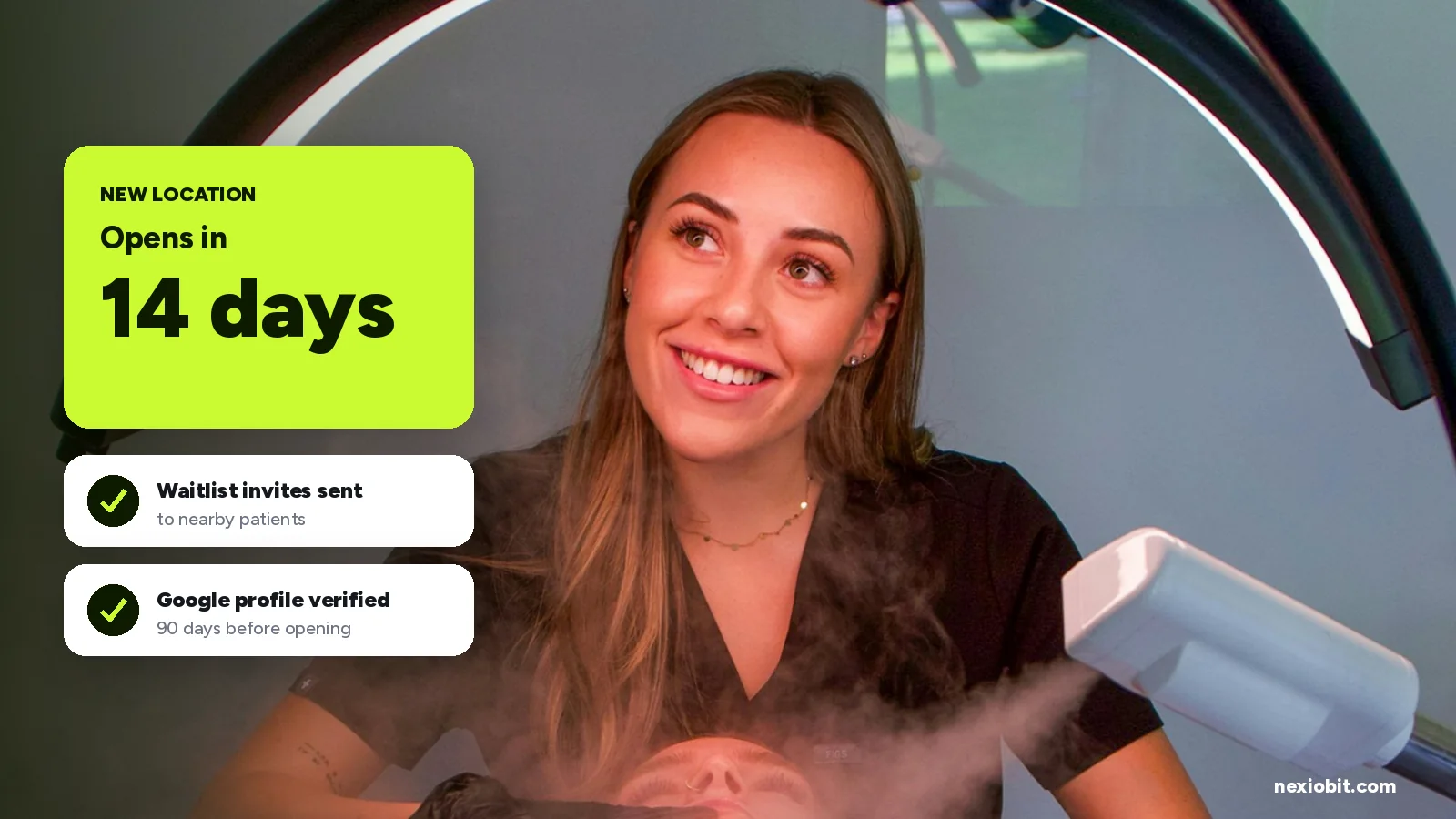
| 60 days before | Publish the location page with a waitlist. Invite existing patients who live nearby (and have opted in to messages) to join it. List the location on Apple Maps, Yelp, Bing, and Facebook with identical details. |
| 30 days before | Introduce the team on social media. Reach out to local press and nearby businesses. Turn on review requests for the new location. |
| 14 days before | Run a soft opening for waitlist patients and local partners. Ask every guest for a review. Test every booking path on a phone, including after hours. |
| Opening and first 30 days | Turn on local ads. Check lead response daily. Compare the new location’s scorecard to your established locations every week. |
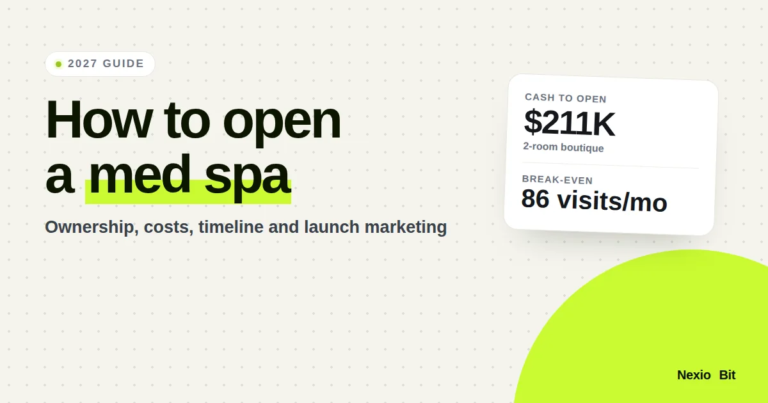
Our guide to opening a med spa covers the legal and build-out side, including ownership structures and timelines, and the startup cost calculator shows your cash to open and break-even month for a new location.
Opening a location in the next 6 months? We’ll map the 90-day launch for it: Google profile, location page, review plan, call routing and local ads, in writing within 7 days.
Plan my next locationCompliance across locations and states
Expanding within one state is mostly an operations challenge. Expanding into a new state is a legal one. Who can own a med spa, who can perform each treatment, how supervision works, and what your marketing can claim all change at the state line.
The rules are also moving. Several states introduced new med spa bills in early 2026 covering licensing, supervision, and scope of practice, and new laws in California and Oregon are tightening how management services organizations can control medical practices. That affects how many multi-location groups are structured.
For marketing specifically:
- Review every claim for every state you operate in. Wording that’s fine in one state may need different supervision language in another.
- Be especially careful with weight loss. Never imply compounded GLP-1 medications are FDA-approved or the same as brand-name drugs.
- Get written consent for every before/after photo and testimonial, at every location.
- Sign a Business Associate Agreement with every vendor that touches patient data, including your CRM, phone, chat, and review tools.
- Collect text-message consent on every location’s forms before sending marketing texts.
This is general information, not legal advice. Before opening in a new state, talk to a healthcare attorney licensed there.
Budgeting per location
Think of multi-location marketing as two budgets: an ongoing budget for every location, and a launch budget for each new one.
The ongoing budget
As a general benchmark, most med spa owners invest around 7–10% of monthly revenue in marketing, including ad spend. Apply that per location, then adjust. A mature location with a full calendar may need less paid spend. A location with open chairs needs more.
Multiple locations also give you economies of scale. Your CRM, website, brand creative, and much of your content are shared costs, so each new location adds less overhead than the first one did. Put the savings into the local work that actually differs: reviews, listings, and local ads.
The launch budget
Budget separately for each new location’s first months. In our startup cost model, a two-room boutique location plans for roughly $15,500 in launch marketing plus about $4,000 a month after opening. Your numbers will vary by market, but the principle holds: a new location needs more marketing per dollar of revenue until its reviews and rankings catch up.
For the full budget breakdown, see the cost section of our med spa marketing plan.
Agency, in-house, or both?
Most groups follow a similar path. The owner handles marketing at one location. Somewhere around two or three locations, that stops working, and they bring in a marketing coordinator, an agency, or both. By five or more, there’s usually a marketing lead in-house working with specialists for SEO, ads, and automation.
If you’re hiring an agency for a multi-location group, ask questions a single-location agency can’t answer well:
- “Show me a report broken down by location.” If they only report group totals, they can’t help you find the weak site.
- “How do you set up Google profiles and location pages?” Listen for one profile and one unique page per location.
- “How do you keep our locations from competing with each other?” Both in ads and on the website.
- “How fast can you launch a new location?” Ask for their pre-opening timeline.
- “How do you price as we add locations?” Per-location pricing with a shared base is common and fair. (Ours is published: multi-location websites start at $7,500 on our med spa website design page.)
- “Who owns the accounts?” You should own every ad account, listing, domain, and CRM.
- “How do you handle HIPAA and different state rules?” A real answer includes a BAA and a claims review process.
Our guide to choosing a med spa marketing agency covers the general vetting questions, too.
How NexioBit helps multi-location med spa groups
If you’d rather have someone build this for you, this is what we do. NexioBit works only with US med spas, and for groups we set up the shared system once, then roll it out location by location:
- Google profiles and location pages for every location, built to the standard in this guide
- One CRM for the group (GoHighLevel), with each lead tagged by source and location from the first message
- NexioFront, our AI receptionist, answering calls, chats and forms in seconds and booking into the right location’s calendar
- Automated review requests after every visit, tied to the provider and location
- Google and Meta ads with treatment campaigns per location and one conversion setup
- A monthly scorecard comparing every location on the same numbers
- A 90-day launch plan for each new location
Pricing: we publish our website pricing (multi-location sites start at $7,500), and ongoing work is priced per location on a shared base, so adding a location doesn’t mean paying for the whole system again. You own every account, listing and domain from day one.
Want to see where each of your locations stands? Book a free 30-minute review. We’ll look at every location’s Google profile, reviews and lead response, and send you a written plan within 7 days, whether or not you hire us.
Book a free location reviewMistakes to avoid
1. Cloning location one’s marketing
Different neighborhood, different competitors, different patients. Use the same systems, but build each location’s local presence from scratch.
2. One combined report
Group totals hide problems. Every location gets its own scorecard.
3. Letting every manager run their own ads
You end up bidding against yourself with tracking nobody trusts. Keep accounts central and campaigns local.
4. Opening with zero reviews
Start asking at the soft opening, and aim for 20 genuine reviews as fast as you can.
5. Copy-paste location pages
Swapping the city name on identical pages rarely ranks. Write something real about each location.
6. Equal budgets for unequal locations
Spend where there’s capacity to fill, not where it feels fair.
7. Memberships that only work at one address
Your locations are a retention advantage. Let patients use them.
Questions owners ask when they add a location.
Short answers. The sections above have the detail.
Should each med spa location have its own Google Business Profile?
Yes. Every location that sees patients at a real address during posted hours should have its own profile, with the same brand name, “Medical spa” as the primary category, its own phone number, its own booking link, and only the services that location offers. Each profile competes in its own neighborhood, so a strong listing at one location doesn’t help another location rank.
Should each location have its own website?
Usually not. One website on one domain with a dedicated page for each location keeps your authority in one place and is far easier to manage. Each location page should have unique content: the team, the treatments offered there, directions, parking, local reviews, and a booking button for that location’s calendar.
How do I stop my med spa locations competing with each other on Google?
In the map pack, distance does most of the work, so nearby locations rarely compete there. The risk is on your website and in ads. Keep one strong page per treatment and list the locations that offer it, rather than copying the page for every city. In ads, run one account with location campaigns that target areas that don’t overlap, so you never bid against yourself.
How much should a multi-location med spa spend on marketing?
As a general benchmark, most med spa owners invest around 7–10% of monthly revenue in marketing, including ad spend. Apply it per location, then move budget toward locations with open capacity. New locations need a separate launch budget; in our startup cost model, a two-room location plans for about $15,500 in launch marketing plus roughly $4,000 a month after opening.
When should I start marketing a second med spa location?
About 90 days before opening. Create and verify the Google profile first, since verification takes time. Then publish the location page with a waitlist, invite existing patients who live nearby, set up listings on Apple Maps, Yelp, and Bing, and run a soft opening two weeks out to collect your first reviews.
What’s the best software for a multi-location med spa?
It depends on your clinical workflow, but the non-negotiable is one system where you can see every location separately and the whole group together: leads by source, bookings, show rate, rebook rate, and revenue by location. Many groups pair a clinical scheduling and charting system with a marketing CRM for lead follow-up and reporting. Check that every vendor will sign a Business Associate Agreement.
What should I look for in an agency for a multi-location med spa?
Ask to see a report broken down by location, how they build Google profiles and location pages, how they keep locations from competing, how fast they can launch a new location, how pricing works as you add locations, and who owns the accounts. An agency that only reports group totals can’t help you find the location that’s slipping.
Can patients use a membership at any location?
They should. A membership that works at every location is harder to cancel when a patient moves or changes jobs, and it’s an advantage single-location competitors can’t offer. Credit the revenue to the patient’s home location so your location reports stay fair, and set clear rules if prices differ between markets.
Does marketing work differently for a franchise or partner-owned med spa group?
The tactics are the same, but who controls them changes. In a franchise, brand, website and compliance usually stay central while each owner runs local ads within brand rules. With partner-owned locations, agree in writing how ad spend is split and which leads belong to which location before you launch anything. In every model, the business should own every ad account, listing and domain.
Abubakar Nazir
Founder & Principal · NexioBit
I run NexioBit, a marketing agency that works exclusively with US medical spas. We build the Google profiles, location pages, CRM systems, and AI receptionists that help each location turn searches into booked appointments. If you’re running more than one location or planning the next one, I’m happy to look at your setup and tell you honestly what I’d fix first.
More about NexioBitRunning more than one location? Let’s look at all of them.
30-minute call. I’ll review each location’s Google profile, reviews, lead response, and reporting, then send a written audit with the 15–30 highest-impact fixes within 7 days, including a launch plan if you’re opening another location.
Book my free audit