Med Spa GEO: How to Get Your Practice Cited by ChatGPT & AI Overviews
Patients are asking ChatGPT, Perplexity, and Google AI Overviews “what’s the best med spa near me?” before they ever open a search results page. This is the honest guide to getting cited in those answers: what GEO actually is, why most med spas are invisible, and the concrete steps that change it.
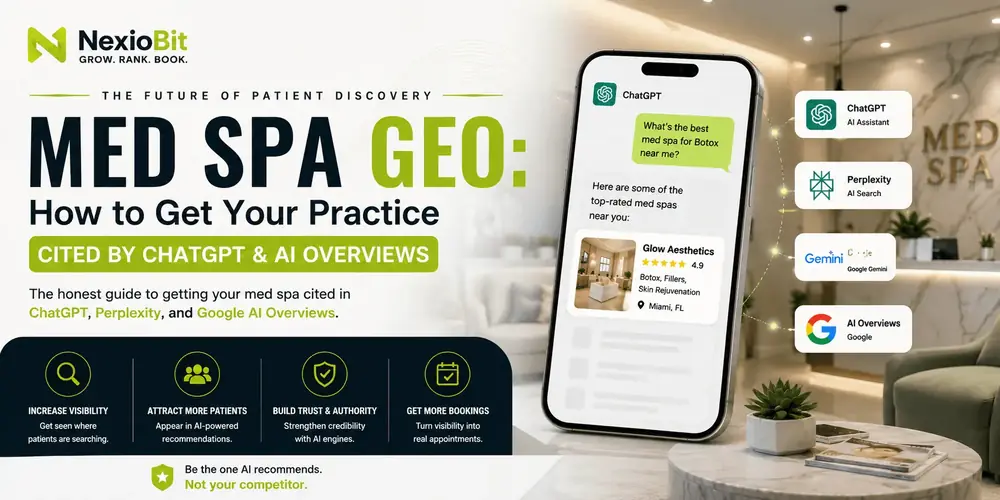
GEO (Generative Engine Optimization) is the work of getting your med spa cited when patients ask AI tools, ChatGPT, Perplexity, Gemini, and Google AI Overviews, for recommendations. It’s becoming a real patient-discovery channel, and most independent med spas are completely invisible in it.
The fix isn’t a trick. It’s structured content, third-party authority, and clear entity signals that AI engines can read and trust. This guide covers what GEO is, why your practice is likely invisible right now, and the concrete steps to change it, in plain language for owners.
- What GEO (Generative Engine Optimization) actually is
- Why AI citation is becoming a real patient channel
- Why your med spa is probably invisible in ChatGPT right now
- How AI engines decide which med spas to cite
- How to get cited: the 6 concrete steps
- How to get into Google AI Overviews specifically
- How to check if your med spa is being cited
- Realistic timeline and what actually moves it
What is GEO (Generative Engine Optimization) for med spas?
GEO, or Generative Engine Optimization, is the practice of structuring your content and online presence so AI answer engines cite your med spa when patients ask them for recommendations. Where traditional SEO gets you ranked in Google’s list of links, GEO gets you named inside the single answer an AI gives, when someone asks ChatGPT, Perplexity, Gemini, or Google’s AI Overview “what’s the best med spa for Botox near me?”
It’s closely related to AEO (Answer Engine Optimization), and the terms are often used interchangeably. The core idea is the same: patients increasingly get one synthesized answer instead of ten blue links, and you want to be inside that answer. It’s exactly the problem a modern medical spa SEO company now solves alongside traditional rankings, not as an afterthought.
There is no “page 2” in an AI answer. Either the AI names your practice, or you don’t exist in that conversation.
Why does AI citation matter for med spas now?
Because patient discovery is genuinely shifting. A growing share of people researching Botox, fillers, or weight-loss treatments now start by asking an AI assistant instead of typing into Google. When the AI returns a shortlist of practices, the ones it names get the consideration, and the ones it doesn’t are simply never seen.
The scale of the gap is documented. A 2026 industry benchmark, the 5W Med Spa & Aesthetic Medicine AI Visibility Index, found that the top 25 brands in aesthetic medicine control roughly 95% of all AI citation share, while the other 11,500+ independent med spas in the US collectively split under 5%. In other words, almost every independent practice is currently invisible to AI-driven patient research.
That sounds bleak, but it’s actually the opportunity. Because so few independent practices have done any GEO work at all, the field is wide open. Being early, with genuinely well-structured content and real authority, is a first-mover advantage that gets harder to win every quarter.
Why is my med spa invisible in ChatGPT and Perplexity?
Most med spas are invisible to AI for three structural reasons, and none of them are about how good the practice is at treatments.
- No structured data. AI engines rely heavily on schema markup and clean, machine-readable content to understand what your business is. If your site has no MedicalBusiness or LocalBusiness schema, the AI has to guess, and it usually guesses someone else.
- No third-party authority. AI engines cite brands they can verify through independent sources, industry directories, review platforms, and earned media. A practice that only exists on its own website has nothing external for the AI to corroborate.
- Content written for humans skimming, not machines extracting. Long, vague, marketing-flavored pages give AI nothing clean to quote. Direct, question-and-answer content gives it exactly what it needs.
The encouraging part: all three are fixable, and they overlap almost entirely with good SEO and good content. GEO isn’t a separate discipline you bolt on, it’s a lens you apply to the fundamentals.
How do AI engines decide which med spas to cite?
Based on how these systems work and what the visibility research shows, AI engines lean on a consistent set of signals when choosing who to name.
| Signal | What it means | How much it matters |
|---|---|---|
| Third-party authority | Mentions on directories, review sites, and earned media the AI can verify independently | Very high |
| Structured data (schema) | Machine-readable markup describing your business, services, and location | High |
| Outcome-focused content | Content framed around what patients search (results, safety, cost), not equipment names | High |
| Credentialed authorship | Content tied to named, board-certified providers (MDs, NPs, RNs) | High (medical category) |
| Clean crawl access | Whether AI crawlers can actually read your site | Moderate but mandatory |
One finding from the visibility research is worth internalizing: dermatology groups with board-certified MDs out-cited most large chains, and equipment-focused device brands were largely invisible. In a medical category, credentialed, outcome-focused authority is the signal AI weights most heavily, not ad spend or location count.
How do I get my med spa cited by AI? The 6 steps
Here are the concrete moves, in order of impact, that make a med spa citable by AI engines.
Add MedicalBusiness and LocalBusiness schema
Structured data is how AI engines read your business unambiguously. Add schema covering your name, address, phone, services, hours, and reviews. Use MedicalBusiness (not just LocalBusiness) since you’re a medical category. Test it with Google’s Rich Results Test.
Restructure content as question-and-answer
AI engines extract clean, direct answers. For every treatment, answer the real questions patients ask (“how much does Botox cost,” “is Sculptra safe,” “how long does it last”) with a tight, direct answer first, then detail. FAQ sections with FAQPage schema are especially citable.
Build third-party authority
AI cites what it can verify elsewhere. Get listed and reviewed on aesthetics platforms (RealSelf, Healthgrades), earn local press mentions, and pursue genuine industry citations. Independent corroboration is what separates a citable practice from an invisible one.
Attribute content to credentialed providers
In a medical category, authorship matters. Tie your treatment pages and educational content to your named medical director or licensed providers, with visible credentials and bios. This is the E-E-A-T signal AI weights most in health topics.
Write for outcomes, not equipment
Patients ask AI about results (“non-surgical skin tightening,” “fat reduction without surgery”), not machine names. Frame your content around the outcome the patient wants, then mention the device. Outcome-language content gets cited; equipment-brand content gets skipped.
Make sure AI crawlers can actually read your site
None of the above matters if AI can’t access your pages. Keep content in real HTML (not locked behind heavy JavaScript), keep your site fast, and don’t accidentally block AI crawlers in robots.txt. Clean crawl access is the unglamorous prerequisite.
Notice how much of this overlaps with strong SEO. GEO and traditional search reinforce each other, which is why they’re handled together in a complete medical spa SEO program rather than as separate projects.
How do I get my med spa into Google AI Overviews?
Google AI Overviews pull from the same signals as traditional search, plus a strong preference for content structured as clear questions and answers. To improve your odds of being featured: answer specific patient questions in 50 to 70 words directly under a question heading, add FAQPage schema, keep your Google Business Profile fully optimized, and build the third-party authority that makes Google confident citing you in a medical context.
There’s meaningful overlap with winning featured snippets: the same tight, direct, well-structured answers that earn snippets are what AI Overviews extract. If you’re already doing question-based content for SEO, you’re most of the way there.
How do I check if my med spa is being cited by AI?
You can audit this yourself in about 15 minutes, no tool required. Open ChatGPT, Perplexity, Gemini, and Google (with AI Overviews on), and run the queries a real patient would:
- “Best med spa in [your city]”, do you appear? Who does?
- “Where should I get Botox in [your city]?”, note which practices get named.
- “[Your practice name] reviews”, does the AI describe you accurately, or get it wrong?
- “Best place for [your top treatment] near me”, check each engine separately; they differ.
- Note the gap. Where competitors appear and you don’t is your priority target list.
Run these monthly. The pattern of who gets cited (and who doesn’t) tells you exactly where to focus your authority-building. If a competitor keeps appearing, look at what independent sources mention them, that’s usually the difference.
How long does GEO take, and what actually moves it?
GEO is slower than flipping a switch and faster than traditional SEO in one respect: once you’re cited by independent authoritative sources, AI engines tend to pick it up relatively quickly on their next crawl. But building that third-party authority, the earned media, the credible citations, the structured content, takes months of consistent work, not days.
What moves it fastest, based on the visibility research, is the combination of structured content plus genuine third-party authority. Practices that invested in schema, earned media, and outcome-focused content consistently out-cited larger competitors who relied on ad spend and location count. The lever is credibility AI can verify, not volume.
The honest bottom line: GEO is a real, growing channel where most of your competitors are currently doing nothing. Starting now, with the fundamentals in this guide, is how you claim citation share while it’s still cheap to win.
The AI search questions med spa owners actually ask me.
Direct answers to the GEO and AI citation questions I hear most from medspa owners.
What is GEO for med spas?
GEO (Generative Engine Optimization) is structuring your content and online presence so AI answer engines cite your med spa when patients ask for recommendations. Where SEO gets you ranked in Google’s links, GEO gets you named inside the single answer ChatGPT, Perplexity, Gemini, or Google AI Overviews gives, when someone asks “what’s the best med spa near me?”
Why is my med spa not showing up in ChatGPT?
Usually three reasons: no structured data (schema) for AI to read your business cleanly, no third-party authority (directories, reviews, earned media) for AI to verify you independently, and content written for skimming rather than extraction. All three are fixable, and they overlap heavily with good SEO.
How do AI engines decide which med spas to recommend?
They lean on third-party authority they can verify, structured data (schema), outcome-focused content, and credentialed authorship. In medical categories, board-certified provider authority is weighted heavily, industry research shows dermatology groups with MDs out-citing much larger chains that relied on ad spend and location count.
How do I get cited in Google AI Overviews?
Answer specific patient questions in 50 to 70 words directly under a question heading, add FAQPage schema, keep your Google Business Profile fully optimized, and build third-party authority. It overlaps strongly with winning featured snippets, the same tight, structured answers that earn snippets are what AI Overviews extract.
What’s the difference between GEO, AEO, and SEO?
SEO gets you ranked in traditional search results. GEO (Generative Engine Optimization) and AEO (Answer Engine Optimization), often used interchangeably, get you cited inside AI-generated answers. They share most fundamentals: structured content, schema, and authority. GEO is best treated as a lens on good SEO, not a separate discipline.
Can I check my med spa’s AI visibility myself?
Yes, in about 15 minutes. Ask ChatGPT, Perplexity, Gemini, and Google (AI Overviews on) the queries a patient would, like “best med spa in [city]” or “where should I get Botox in [city].” Note who gets named and whether you appear. Where competitors show up and you don’t is your priority target list. Repeat monthly.
Abubakar Nazir
Founder & Principal · NexioBit
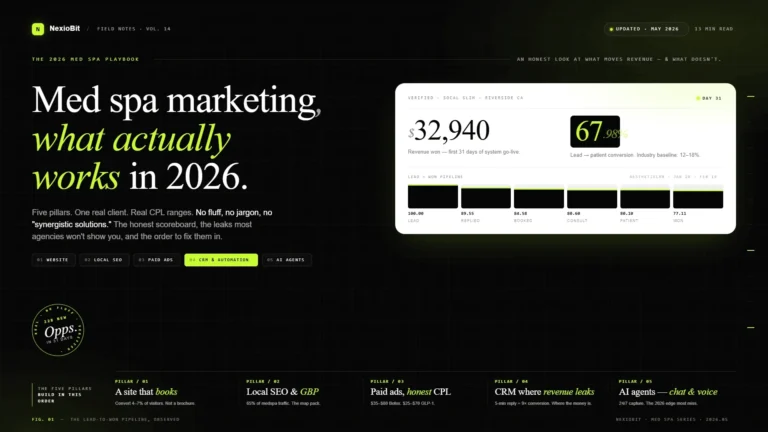
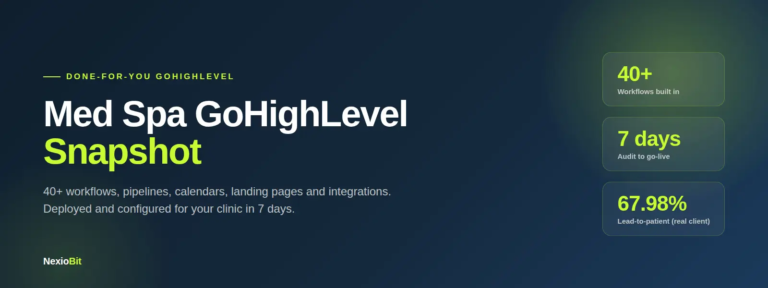
I run NexioBit, an AI-powered marketing agency that works exclusively with US medical spas. We build complete medspa marketing systems, SEO foundation, GEO, paid ads, AI voice, CRM, and reviews. One recent client build, SoCal Slim in Riverside, CA, produced 228 opportunities and $32,940 in won revenue in 31 days. If you want me to check where your practice stands in AI search and tell you the fixes that would move it fastest, that’s a free 30-minute conversation. No sales rep, no slides.
Read the full SEO guideWant to know if AI recommends your med spa?
30-minute call. I’ll check where your practice shows up across ChatGPT, Perplexity, and Google AI Overviews, then tell you the 2 specific fixes that would improve your AI citation share fastest. Free if it doesn’t help; honest either way.
Book my free AI visibility check