Medical Spa SEO: The Complete 2026 Guide for Practice Owners
A deep, vendor-neutral guide to ranking your medspa on Google. Local SEO, technical SEO, content strategy, and the honest math on what an SEO company actually does for you. Real timelines, real costs, and the questions to ask before you hire anyone.
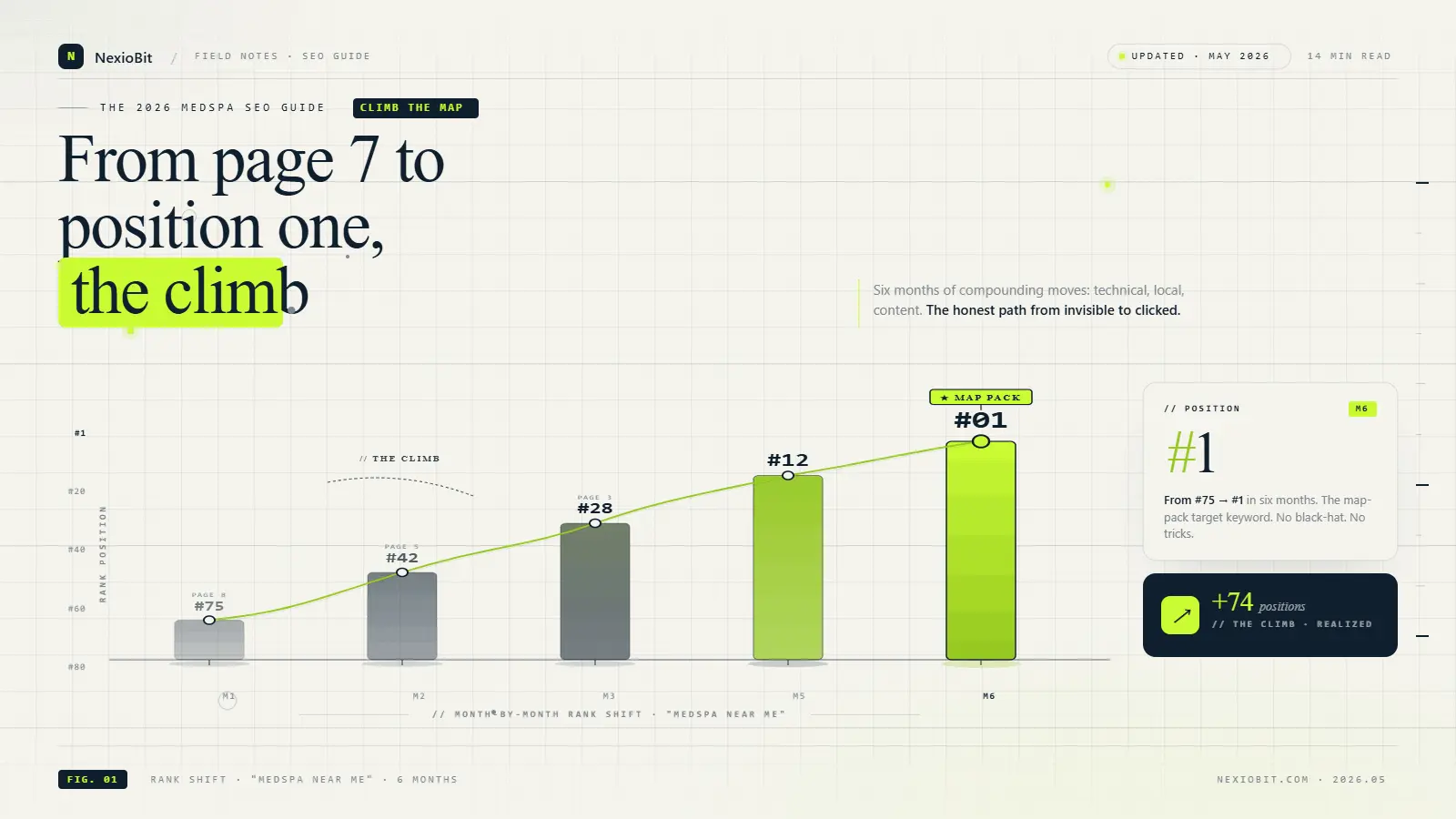
Medical spa SEO is the work of getting your practice to rank on Google when someone searches “medspa near me,” “botox [your city],” or specific treatments you offer. Done well, it produces 40-70% of new patient revenue for established medspas without ongoing ad spend.
It is not magic. It is six concrete workstreams (Google Business Profile, technical SEO, on-page content, local citations, reviews, and link building) executed consistently over 90 to 180 days. This guide breaks down each one with real numbers, real timelines, and the honest math on whether to hire an SEO company or do it in-house.
- What medical spa SEO actually is (and isn’t)
- Why SEO matters more for medspas than most service businesses
- The six pillars of medspa SEO that actually move rankings
- Google Business Profile: the single biggest win
- Technical SEO: the foundation most medspas skip
- Content strategy: treatment pages, blogs, and what to write
- Local citations and directories that still matter in 2026
- Reviews: the underrated ranking factor
- Backlinks: the hard part most agencies skip
- Realistic timeline: when SEO starts producing revenue
- What med spa SEO actually costs in 2026
- When to hire a medical spa SEO company vs. do it in-house
What medical spa SEO actually is (and isn’t)
Medical spa SEO is the work of making your practice show up on Google when potential patients search for the services you offer. That’s the entire definition. Everything else is tactics.
When someone in your city searches “botox near me” or “laser hair removal [your city],” Google decides which medspas to show in the top 3 map results (the “local pack”) and which 10 websites to show on the first page below. SEO is the practice of earning those positions through technical, content, and authority signals that Google trusts.
What it is NOT:
- SEO is not paid ads. If you’re paying Google to appear at the top of search, that’s SEM (Google Ads), not SEO. They’re different disciplines with different economics.
- SEO is not a one-time setup. Competitors are working on theirs too. The medspa that ranks #1 today rarely stays there without ongoing work.
- SEO is not just keywords. Stuffing “botox in [city]” into your website 50 times stopped working around 2012. Modern SEO is about real expertise, real local relevance, and real authority.
- SEO is not a 30-day project. Anyone promising rankings in 30 days is selling you something other than SEO.
If you remember one thing: Google ranks the most useful, trustworthy, locally relevant medspa for each search query. Everything in this guide is about how to become that medspa.
Why SEO matters more for medspas than most service businesses
Most service businesses can survive on word of mouth and paid ads. Medspas have a structural advantage and a structural problem that make SEO unusually valuable for the category.
The advantage: high purchase intent + local searches
When someone Googles “medspa near me” or “botox specials [city],” they’re not researching for a school project. They’re a buyer. Roughly 76% of local searches result in an in-person visit within 24 hours, according to widely-cited industry data. Few categories see conversion windows that fast.
Add the local component: medspa customers won’t drive an hour for a botox appointment when there’s a medspa 15 minutes from their house. The geographic limit on your competition is small. You don’t need to outrank every medspa in America, just every medspa in your 15-mile radius.
The problem: paid ad costs are punishing
The other side of high-intent buyers is that everyone wants them. Google Ads CPCs for medspa keywords run between $8 to $35 per click depending on city and treatment. Cosmetic surgery queries can hit $50+. Compare that to a typical service business CPC of $3 to $8.
If you rely on paid ads exclusively, your customer acquisition cost is permanently anchored to whatever the most-aggressive competitor in your market is willing to pay. SEO is the lever that breaks that dependency. Once your site ranks organically for “botox [your city],” that traffic is essentially free for as long as you maintain the position.
The math: SEO vs. paid ads at scale
| Channel | Year 1 cost | Year 1 traffic | Year 3 cost (cumulative) | Year 3 traffic (annual) |
|---|---|---|---|---|
| Google Ads only | $48,000 ($4K/mo) | ~6,000 clicks | $144,000 | ~6,000 clicks |
| SEO only | $24,000 ($2K/mo) | ~1,200 clicks | $72,000 | ~12,000 clicks |
| Both | $72,000 | ~7,200 clicks | $216,000 | ~18,000 clicks |
SEO compounds. Ad spend doesn’t. By Year 3, the same SEO investment that produced 1,200 clicks in Year 1 is producing 10x that. Ads produce the same clicks every year for the same dollar.
The six pillars of medspa SEO that actually move rankings
Ignore the SEO industry’s 47-point checklists. In 2026, six things matter for ranking a medspa on Google. Everything else is noise or a subset of these. These six pillars are exactly what a proper medical spa SEO company should be executing for you every month.
Google Business Profile (the local pack engine)
Your free Google listing. Determines whether you appear in the 3-result map pack at the top of local searches. The single most impactful SEO asset for any medspa.
Technical SEO (site speed, mobile, structure)
The boring foundation. Site speed, mobile experience, crawlability, schema markup. Google won’t rank a site it can’t read or that loads in 5 seconds.
On-page content (treatment pages, blog, location pages)
The actual pages on your site. Each treatment you offer needs its own dedicated page. Each blog post should answer a specific question your patients are asking.
Local citations (consistent NAP across the web)
Listings on directories like Yelp, Healthgrades, RealSelf, Vitals. Google uses these to verify your business is real. NAP stands for Name, Address, Phone, and they all have to match.
Reviews (Google reviews specifically)
Volume, velocity, and rating of your Google reviews. Direct ranking factor in the local pack. Also drives the click-through rate of your listing once you rank.
Backlinks (other sites linking to yours)
The hardest one. Real editorial links from real sites in your industry. Local news mentions, partnership pages, industry directories. This is what separates page 1 from page 5 in competitive markets.
Most medspa SEO programs fail not because of bad tactics, but because they focus on 2-3 of these pillars and ignore the others. You need all six to compete.
Google Business Profile: the single biggest win
If you do nothing else from this guide, optimize your Google Business Profile (GBP, formerly Google My Business). For most medspas, this single asset drives 50 to 70% of all organic patient acquisition.
The local pack (the 3-listing map result at the top of local searches) is where high-intent searches end. Someone searching “medspa near me” on their phone almost always taps one of those three results, calls or fills the form, and books within the hour. Ranking in that pack is worth more than ranking #1 in organic results below it.
The GBP optimization checklist
- Claim and verify the profile. If you haven’t, do this today. Google sends a postcard or code; takes 5 to 14 days.
- Pick the most specific primary category. “Medical spa” if available, then “Skin care clinic” or “Wellness center” depending on your offerings. Wrong category is the #1 GBP mistake.
- Add every relevant secondary category. Treatment-specific ones like “Laser hair removal service,” “Beauty salon,” “Weight loss service” if applicable.
- Hours, phone, website, address: 100% accurate. Update for holidays. Inconsistencies hurt ranking.
- Service menu: every treatment, with description and price range. Most medspas leave this empty. Filling it out is a major differentiator.
- 20+ photos minimum. Interior, exterior, treatment rooms, before/after (compliance-permitting), staff, products. Update monthly.
- Q&A section: pre-populate the top 10 questions. You can ask and answer your own questions. Most medspas don’t.
- Posts: 1 per week minimum. Treatment specials, educational content, events. Posts are a ranking signal.
- Attributes: tick every relevant one. “Women-led,” “LGBTQ+ friendly,” “Wheelchair accessible,” etc. Each one increases visibility for relevant filters.
- UTM-tagged website link. Use a URL with `?utm_source=gbp&utm_medium=organic` so you can track GBP traffic in Google Analytics.
The GBP ranking factors
Google’s local algorithm uses three primary factors:
- Relevance. How well your profile matches the searcher’s query. Driven by category, services listed, and the words in your description and reviews.
- Distance. How close your address is to the searcher’s location. You can’t change your address, but you can target searches from your specific neighborhood by getting reviews that mention nearby landmarks.
- Prominence. How well-known your business is. Driven by review count, review rating, link mentions, brand searches, and citations.
You can move all three over time. Distance is the most fixed (without opening a second location), but relevance and prominence are entirely earnable.
Technical SEO: the foundation most medspas skip
Technical SEO is the unsexy work that most medspa SEO companies underdeliver on. It’s not glamorous. There’s nothing to show off in a client report. But Google won’t rank a slow, broken, or unindexable site no matter how good the content is.
The technical SEO must-haves
1. Site speed (sub-2-second LCP on mobile)
Google measures Largest Contentful Paint (LCP) as the most important speed metric. For medspa sites, the target is under 2.0 seconds on mobile. Most medspa sites we audit are at 3.5 to 6.5 seconds. Every second over 2 costs you patients (and rankings).
The biggest culprits are usually: oversized hero images (use WebP, max 200KB), too many plugins (audit and remove anything unused), slow hosting (move off shared hosting), and unoptimized fonts. Test your site at PageSpeed Insights and prioritize anything red.
2. Mobile-first design (not just mobile-friendly)
Google indexes mobile-first since 2020. If your site looks great on desktop but cramped on a phone, you’re losing rankings. Test on a real iPhone, not just a browser resize. Buttons should be tappable, text readable without zoom, forms easy to complete one-handed.
3. Schema markup (LocalBusiness + MedicalBusiness)
Schema is structured data that tells Google explicitly what your site is. For medspas, the relevant schemas are MedicalBusiness and LocalBusiness. Add hours, address, phone, services, accepted payment methods, and reviews schema. Test with Google’s Rich Results Test.
4. URL structure (clean and descriptive)
Use URLs like yoursite.com/treatments/botox/ not yoursite.com/page?id=247&cat=12. Keep them short, descriptive, and treatment-specific. Each treatment page gets its own URL.
5. HTTPS and core technical hygiene
SSL certificate active (browser shows padlock). Sitemap.xml submitted to Google Search Console. Robots.txt configured correctly. No broken links. No duplicate content. 301 redirects in place for any old URLs you’ve moved. Boring but mandatory.
Content strategy: treatment pages, blogs, and what to write
Content is where most medspa SEO programs go off the rails. Either they don’t publish enough (one blog every three months) or they publish too much fluff (10 articles a month, none of which rank). The right cadence and focus matters more than volume.
Treatment pages: one per service, properly built
Every treatment you offer needs its own dedicated page. Not a section on a longer page. A real, indexable URL like yoursite.com/services/botox/. This is the highest-impact on-page SEO work for any medspa.
Each treatment page should include:
- 1,200 to 2,000 words of useful content. Short pages don’t rank for competitive medspa terms.
- What the treatment is in plain language
- Who it’s for (and who it’s not for)
- How long it takes and what to expect
- Pricing (or starting price; even a range beats nothing)
- Recovery time and aftercare
- Results timeline
- FAQ section (5-10 questions you actually get asked)
- Real photos (your practice, your equipment, your staff, your before/afters where compliance allows)
- Clear CTA to book a consult
Blog content: the 80/20 rule
80% of medspa blog content fails because it’s either too generic (“5 benefits of botox”) or too thin (300 words covering nothing useful). The 20% that works follows three patterns:
- Treatment comparison posts. “Botox vs. Dysport: which is right for you?” or “Hydrafacial vs. chemical peel.” High-intent searches where the reader is choosing.
- Local guides. “Best skincare routine for [your city] climate” or “Wedding prep treatments timeline.” Captures local intent that competitors miss.
- Honest answers to specific questions. “Does CoolSculpting hurt?” “How long does laser hair removal last?” “What’s the real cost of botox in [your city]?” Real questions, real answers.
Publish 2 to 4 of these per month. Each one ranks for long-tail queries. The compound effect over 12 months produces meaningful traffic.
Location pages (if you have multiple locations)
If you operate in multiple cities, each location gets its own page: yoursite.com/locations/austin/, yoursite.com/locations/dallas/, etc. Each page needs unique content about that specific location (not just a city name swap). Address, phone, hours, photos, staff, and content relevant to that local market.
Building tools and competitive intelligence platforms like Ahrefs help here: their data shows exactly which keywords have local volume in each city, so you can prioritize the geos that actually move revenue.
Local citations and directories that still matter in 2026
Citations are listings of your business on other websites (Yelp, Healthgrades, RealSelf, etc.). They serve two functions: they verify your business is real to Google, and they drive direct referral traffic from people browsing those directories.
The 2026 reality is that citation services like Yext or Whitespark’s mass citation building no longer move the needle they did in 2018. What still works is a focused list of high-authority directories with consistent NAP information.
The citation directories that still matter for medspas
| Directory | Authority | Cost | Worth it? |
|---|---|---|---|
| Google Business Profile | Highest | Free | Mandatory |
| Yelp | Very high | Free | Yes |
| Healthgrades | High (medical) | Free + paid tiers | Yes, free tier only |
| RealSelf | High (aesthetics) | $300 to $1,500/mo | Only with budget |
| Vitals | Medium (medical) | Free | Yes |
| Facebook Page | High | Free | Mandatory |
| Apple Maps | High | Free | Yes |
| Bing Places | Medium | Free | Yes (10 min setup) |
| Better Business Bureau | Medium | Free + paid tiers | Yes, free tier |
| Chamber of Commerce (local) | Medium | $200 to $600/yr | Often yes |
| Mass citation services | Low | $300 to $1,000/yr | Skip |
The rule: NAP (Name, Address, Phone) must be byte-identical across every listing. “123 Main St.” and “123 Main Street” are different to Google’s algorithm. Audit your existing listings, pick one canonical version, update everywhere.
Reviews: the underrated ranking factor
Reviews are the most underweighted SEO factor in medspa marketing, and the easiest one to fix. Three review-related signals affect rankings:
1. Review volume
The absolute number of reviews on your Google Business Profile. Most established medspas sit at 30 to 150 reviews. Top-ranking medspas in competitive markets typically have 300+. Volume is a trust signal: more reviews = more “real business” energy to Google’s algorithm.
2. Review velocity
How fast new reviews are arriving. A practice that gets 10 reviews per month ranks better than one with the same total review count but a stagnant pace. Velocity signals an active business.
3. Review rating
The average star rating. The sweet spot is 4.6 to 4.9 stars. Surprisingly, 5.0 with low volume looks suspicious; some negative reviews mixed in look authentic. Below 4.3 hurts conversion even if you rank.
The review acquisition system that works
Most medspas have no system for getting reviews. They ask front desk staff to “mention it” and pray. That produces 1-3 reviews per month on a 500-patient month. A real system produces 15-30.
The system that works:
- SMS-triggered review request 4 hours after appointment. Patient experience is fresh, dopamine is high. SMS open rates are 95%+.
- One-tap Google review link. Not “please leave a review” with a URL they have to copy. A direct link that opens the Google review form pre-populated.
- Smart routing for low scores. If a patient indicates dissatisfaction (rated 1-3 internally), they go to a private feedback form, not Google. If they rated 4-5, they go to Google. This protects your public rating without violating Google’s terms.
- Follow-up at 24 hours if no review. One reminder, then drop it.
This is exactly the system we deploy for clients, integrated with their CRM. The full mechanic is documented in our Google review automation playbook.
Backlinks: the hard part most agencies skip
Backlinks (other websites linking to yours) are the hardest part of SEO and the most important for competitive markets. They’re what separates page 1 from page 5 in cities like Los Angeles, Miami, Houston, or Tampa where medspa competition is intense.
Most medspa SEO companies underdeliver here because real backlink work is slow, manual, and unreliable. Easier to bill for “content” than to actually earn links. Here are the link sources that work in 2026:
The backlink sources that move medspa rankings
1. Local news mentions
A feature in your city’s newspaper, lifestyle magazine, or local TV station website. Worth 10x the value of generic directory links. Approach: become a quotable source. Pitch local journalists during seasonal angles (“wedding prep” in spring, “summer skincare” in May, “new year’s aesthetic resolutions” in January).
2. Industry publications and association sites
Modern Aesthetics, Medesthetics, AmSpa member directory, MedSpa Magazine. Each gives you a high-authority backlink and credibility. Worth pursuing one per quarter.
3. Vendor and partner pages
The brands you use (Botox manufacturer, laser equipment maker, skincare lines) often have “find a provider” or partner directories. Each one is a real backlink. Audit your vendor relationships and ask which have provider pages.
4. Local business partnerships
Cross-link with complementary local businesses: wedding planners, fitness studios, hair salons. Mutual referral pages where each business lists the other. Authentic, sustainable, and Google reads them as real local relationships.
5. Guest articles on industry blogs
Write articles for medspa industry publications. Each article includes a byline link back to your site. One article per quarter compounds significantly over 2 years.
What NOT to do
Three backlink tactics actively hurt medspa SEO:
- Buying backlinks from Fiverr. Almost always link farms. Almost always penalized eventually.
- Mass directory submissions. Yext-style spray-and-pray approaches don’t work and look manipulative.
- Private Blog Networks (PBNs). An entire industry of agencies offers these. They produce short-term ranking gains and long-term penalty risk. Avoid.
Realistic timeline: when SEO starts producing revenue
The most-asked question on every medspa SEO discovery call: “how long until I see results?” The honest answer most agencies won’t give:
| Timeline | What you should see | What you should NOT expect |
|---|---|---|
| Month 1 | Audit complete, GBP optimized, technical fixes shipped, content roadmap drafted | Ranking changes (too early) |
| Month 2 | First treatment pages live, citation cleanup done, review velocity increasing | Revenue impact (still too early) |
| Month 3 | Long-tail keywords starting to rank, GBP positions improving, more organic clicks | Top 3 rankings on primary terms |
| Month 4-6 | Real organic traffic growth (2-5x baseline), GBP in top 3-5 of local pack, first attributable patients | Dominant position on every keyword |
| Month 7-12 | Compounding traffic growth, top 3 local pack regularly, organic becomes 30-50% of new patient volume | Smooth, linear growth (it’s lumpy) |
| Year 2+ | Organic as dominant new-patient channel, ad spend can decrease, competitive moat | It running on autopilot (still needs ongoing work) |
Anyone promising rankings or revenue in 30 to 60 days is either lying or about to do something risky that costs you long-term. SEO is a 6 to 12-month commitment. Plan accordingly.
What med spa SEO actually costs in 2026
SEO pricing varies wildly because the industry has no standardization. Here’s the realistic range we see, based on actual market data and what produces results:
| Tier | Monthly cost | What you get | Realistic for |
|---|---|---|---|
| DIY | $0 + your time | GBP, content, basic citations | Pre-revenue or solo practitioners |
| Budget agency | $500 to $1,200 | GBP management, 2-3 blogs/mo, citations | Limited results expected |
| Specialist agency | $1,500 to $3,500 | Full six-pillar program, monthly reporting | Most growing medspas |
| Premium specialist | $3,500 to $7,500 | Above + dedicated strategist, link building | Multi-location or competitive markets |
| Enterprise / multi-location | $7,500 to $20,000+ | Custom strategy, brand-level SEO | Practices doing $5M+ revenue |
The honest caveats
- Below $1,000/month, you cannot get real SEO. The math doesn’t work for an agency to deliver real work at that price. You’re getting templated outputs. For a benchmark, our med spa SEO services run $1,500–$3,500/month with the full scope and pricing published — compare any quote against that.
- Above $5,000/month for a single-location medspa, you’re paying for capabilities you won’t use. Unless you’re in a hyper-competitive market (LA, Miami, NYC) or have multi-location complexity.
- Initial setup work is often billed separately. Expect $1,500 to $5,000 in month-1 setup fees on top of the ongoing retainer.
- Real ROI math: If a typical patient is worth $1,500 lifetime value and your SEO retainer is $2,500/month, you need 2 patients/month attributable to SEO to break even. Most successful programs hit that by month 4-6 and 5-10x it by month 12.
When to hire a medical spa SEO company vs. do it in-house
The DIY vs. hire decision comes down to three honest questions:
1. Do you have someone in-house who has done this before for a medspa?
Not someone who has done “digital marketing” in general. Someone who has personally ranked a medspa on Google’s local pack. If yes, in-house can work. If no, you’re paying tuition while they learn, and the tuition is your competitive position.
2. Do you have 10 to 15 hours per week to commit to SEO consistently for a year?
SEO is the work, not the strategy. Writing treatment pages, managing GBP, responding to reviews, building citations, doing outreach for backlinks. If you can’t commit the hours, a partial in-house effort produces partial results and partial frustration.
3. Is your competitive market easy or hard?
Easy markets (small towns, low medspa density) can be won DIY with consistent effort. Hard markets (LA, Miami, Houston, Phoenix, NYC) require professional execution because your competitors are running real SEO programs and you need to match the operational tempo.
The 4 questions to ask every med spa SEO company you interview
If you do hire, the agency you pick matters more than the price. (Here’s exactly what our med spa SEO service includes — judge us by the same four questions below.) Four screening questions:
- “Show me 90-day reports from 2 medspa clients with revenue attribution.” Not traffic charts. Real revenue attribution.
- “What’s your monthly content output? How many treatment pages do you write per quarter?” Vague answers mean templated outputs. Specific answers (“6 treatment pages per quarter, 8 blogs, 1 outreach campaign”) mean real systems.
- “What’s your link building approach?” If they say “we don’t do link building,” they’re skipping the hardest pillar. If they say “we have a network of sites we use,” they’re running PBNs and you should run.
- “What happens at month 6 if I’m not seeing results?” A real agency has a process for course correction. Bad agencies say “SEO takes time” for another 6 months while billing you.
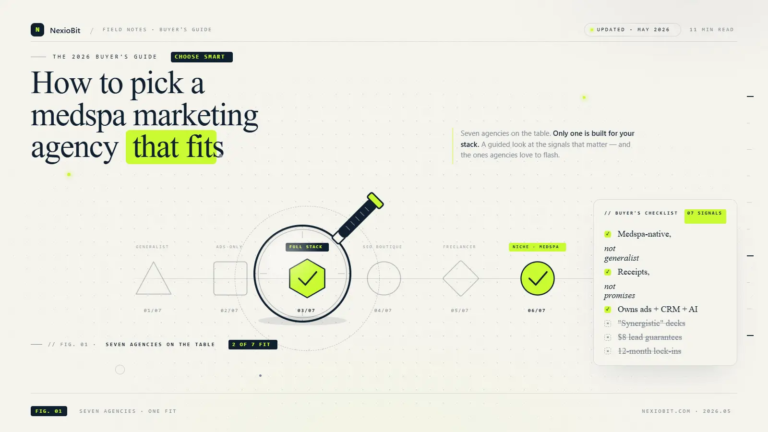
For the deeper version of agency vetting, see our guide to choosing a med spa marketing agency. The same 7 questions apply to SEO companies specifically.
What success looks like (real numbers from a real medspa)
To make this concrete, here’s what a properly-executed program produces. One of our clients in Riverside, CA used the system above as part of a broader marketing build:
SoCal Slim, Riverside CA · First 31 days of the engagement
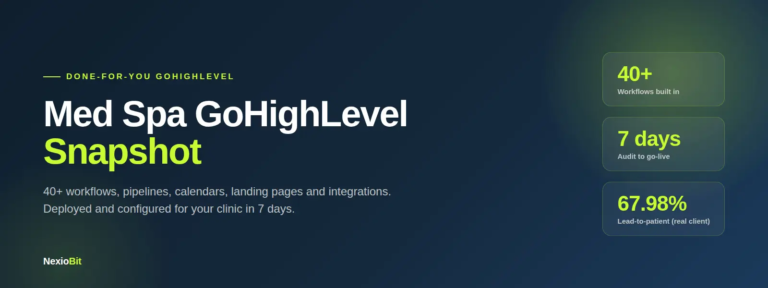
That number is 31 days of a multi-channel build, not pure SEO output. But the underlying SEO foundation (GBP optimization, treatment pages, review velocity, technical fixes) is what made the paid traffic + AI voice agent convert at 67.98%. SEO and conversion infrastructure compound together; neither works as well alone.
How to start: the first 30 days
If you’re reading this and want to start, here’s the priority order for your first 30 days regardless of whether you DIY or hire:
- Week 1: Claim and fully optimize your Google Business Profile. This alone often produces 30 to 50% of all the SEO gains you’ll see in year 1.
- Week 1-2: Run a technical audit (PageSpeed Insights, mobile-friendly test, broken link check). Fix anything red.
- Week 2-3: Set up a review request system. Target: 15+ new Google reviews in the first 60 days.
- Week 3-4: Write or rewrite your top 3 treatment pages. Botox, fillers, and your highest-revenue treatment. 1,500+ words each, FAQ sections, real photos.
- Week 4: Audit citation consistency. Make sure NAP matches across Google, Yelp, Facebook, Apple Maps, Healthgrades. Update any mismatches.
That’s 30 days of work. If you do all of it, you’ll see measurable ranking improvement by day 60-90. Add the other three pillars (content cadence, link building, ongoing optimization) and you have a 6-month plan that produces real revenue.
The medical spa SEO questions practice owners actually ask me.
Direct answers to the six questions I hear most from medspa owners during SEO discovery calls.
How long does medical spa SEO take to work?
A realistic timeline is 3 to 6 months for first measurable results and 6 to 12 months for meaningful revenue impact. Month 1-2 is setup (audit, GBP optimization, technical fixes, content roadmap). Months 3-4 show ranking improvements on long-tail keywords. Months 4-6 produce first attributable patients from organic traffic. Months 6-12 compound into 30-50% of new patient volume coming from organic. Anyone promising rankings or revenue in 30 to 60 days is either lying or about to do something risky.
How much does medical spa SEO cost in 2026?
Realistic monthly retainers run $1,500 to $7,500 for most medspas, plus $1,500 to $5,000 in one-time setup fees. Below $1,000/month, the math does not work for any agency to deliver real work, so you are paying for templated outputs. Above $5,000/month for a single location, you are paying for capabilities you will not use unless you are in a hyper-competitive market like LA, Miami, or NYC. Specialist agencies for growing medspas typically land at $2,500 to $4,500/month for the full six-pillar program.
What is the most important medical spa SEO factor?
Google Business Profile optimization, hands down. For most medspas, GBP drives 50 to 70% of all organic patient acquisition because the local pack (the 3-result map at the top of local searches) is where high-intent local searches end. Optimizing your GBP fully (correct primary category, all secondary categories, complete service menu, 20+ photos, weekly posts, attributes, Q&A section) typically produces 30 to 50% of the SEO gains you will see in year 1. It is also the fastest pillar to fix and free.
Can I do medical spa SEO in-house?
Yes, if three conditions are true. First, you or someone on your team has personally ranked a medspa on Google before (general digital marketing experience does not count). Second, you can commit 10 to 15 hours per week to SEO work consistently for at least 12 months. Third, your competitive market is not hyper-competitive (small cities and low-density medspa markets are DIY-friendly; LA, Miami, Houston, Phoenix, NYC require professional execution because competitors are running real programs). If any of those three is no, hiring a specialist returns better ROI than the in-house tuition cost.
What is the difference between local SEO and medical spa SEO?
Medical spa SEO is a specific application of local SEO, with industry-specific considerations layered on. Local SEO covers the general work of ranking a brick-and-mortar business: Google Business Profile, NAP citations, local content, reviews. Medical spa SEO adds: HIPAA-aware content and forms, before/after compliance considerations, treatment-specific page structure (botox, fillers, lasers each get their own page), aesthetic industry directories (RealSelf, Healthgrades, Vitals), medical schema markup (MedicalBusiness, not just LocalBusiness), and an understanding of treatment-specific buyer psychology. Generic local SEO agencies miss these details, which is why specialist medspa SEO companies typically outperform generalists.
How many Google reviews does a medspa need to rank well?
There is no magic number, but for context: most established medspas sit at 30 to 150 reviews, while top-ranking medspas in competitive markets typically have 300+. More important than the absolute total is velocity (how fast new reviews arrive) and rating (4.6 to 4.9 stars is the sweet spot). A practice getting 10+ new reviews per month consistently outranks one with the same total but a stagnant pace. If you have under 50 reviews, target 25 new ones in the next 60 days using an SMS-triggered review request system. That velocity alone often moves you from positions 4 to 6 in the local pack to positions 1 to 3.
Abubakar Nazir
Founder & Principal · NexioBit
I run NexioBit, an AI-powered marketing agency that works exclusively with US medical spas. We build complete medspa marketing systems (SEO foundation + paid ads + AI voice + CRM + reviews). One of our recent client builds, SoCal Slim in Riverside, CA, produced 228 opportunities and $32,940 in won revenue in 31 days. If you want me to audit your medspa’s SEO and tell you the 2 specific fixes that would unlock the most ranking improvement, that’s a free 30-minute conversation. No sales rep, no slides.
See our SEO servicesWant me to audit your medspa’s SEO?
30-minute call. I’ll review your Google Business Profile, site speed, treatment pages, citations, and review velocity. Then tell you the 2 specific fixes that would unlock the most ranking improvement right now. Free if it doesn’t help; honest either way.
Book my free SEO audit