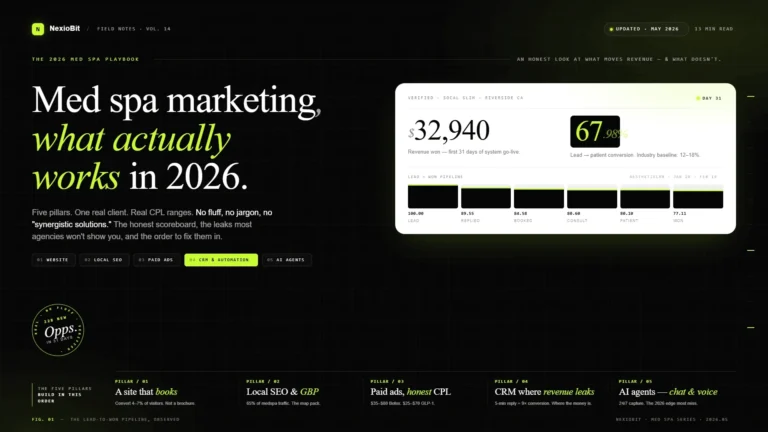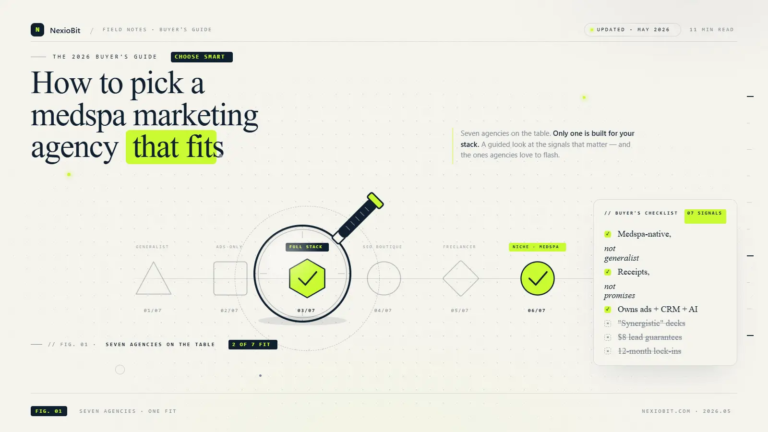
AI Receptionist for Med Spas: The 24/7 AI Voice Agent That Books Consultations
An AI receptionist is an AI voice agent that answers every call, knows your treatment menu, books into your calendar and hands off to your team when it should. Here’s what a med spa AI receptionist should do, what it costs, and how NexioFront handles it. You can talk to ours right now.
Free, right in your browser. Allow microphone access when asked.
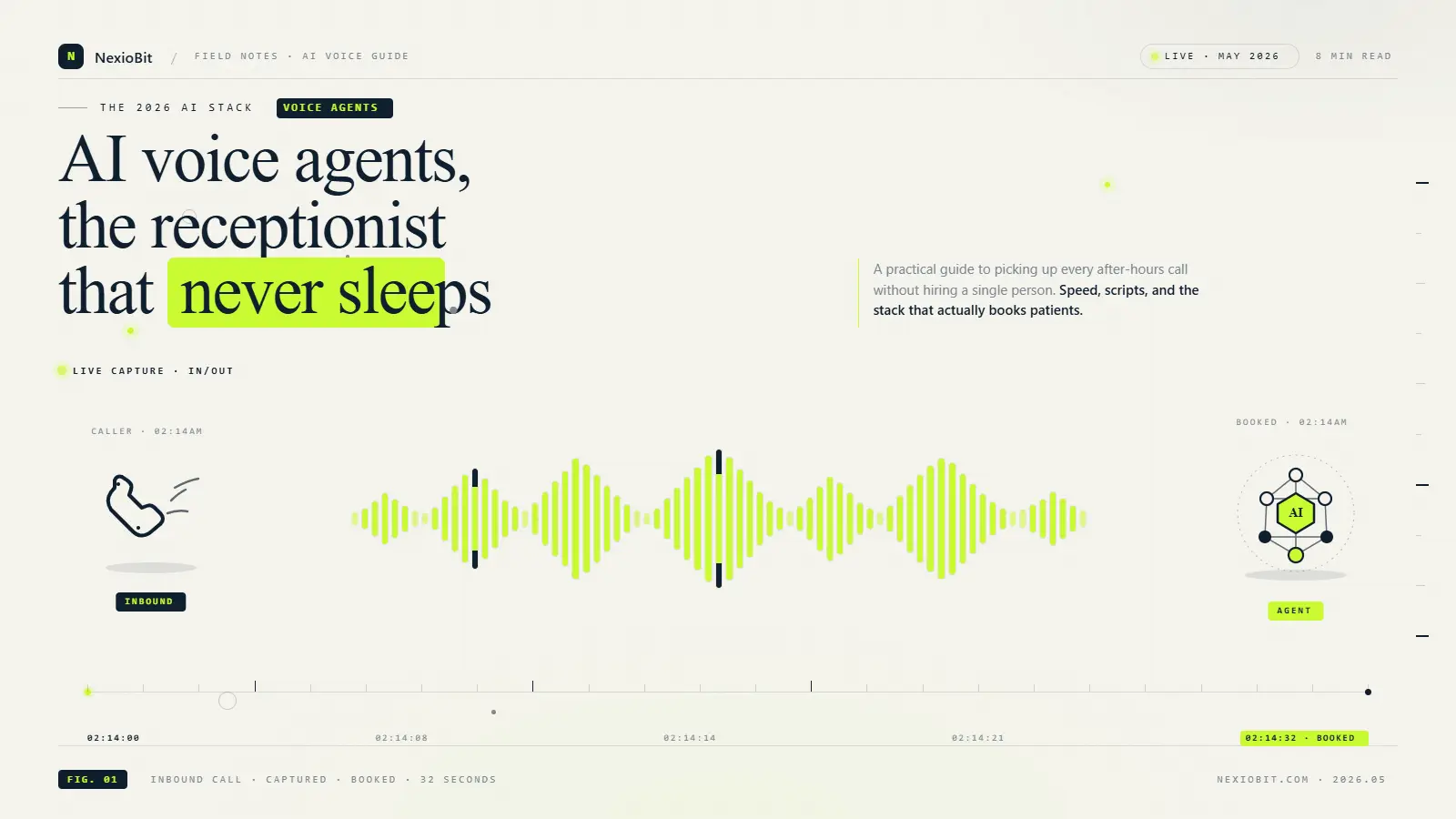
An AI receptionist for a med spa answers every call, including evenings and weekends, answers from your treatment menu, checks live availability and books consultations, and hands off to your team for anything medical or emotional.
The value is in booking, not just answering. Before you pick one, ask every vendor about BAAs, call recording, identity checks and emergency handling. The fastest way to judge one is to talk to it, so try ours below.
What an AI receptionist for a med spa actually is
An AI receptionist for a med spa (also called an AI answering service, virtual receptionist or AI voice agent) is software that answers your phone like a trained front desk: it greets callers by your practice name, answers questions about your treatments, checks your schedule and books consultations. It isn’t a phone tree and it isn’t an outsourced call center.
| Option | What it does | Where it falls short |
|---|---|---|
| Phone menu (IVR) | “Press 1 for…” routing to staff or voicemail | Can’t book or answer pricing; patients hang up |
| Human answering service | Outsourced staff reading your script | Rarely sees your calendar; cost rises with volume |
| AI receptionist | Real conversation, answers from your menu, books, transfers | Needs accurate info and a clear hand-off plan |
Modern AI voice agents for med spas sound natural, handle interruptions and take real actions like checking your calendar and booking. That’s what separates them from the phone menus patients hang up on.
Why med spas lose bookings on the phone
Most med spas don’t have a lead problem. They have an answering problem.
- Calls come when you’re closed. Evenings, lunch breaks and weekends are when many patients finally have time to call, and voicemail rarely gets a second chance.
- Speed decides who books. A patient comparing clinics usually books with whoever answers first. A callback the next morning is often too late.
- The front desk is juggling. Checking in patients, taking payments and answering the phone at once means calls go unanswered even during business hours.
- Reschedules eat staff time. Moving and cancelling appointments is repetitive work that pulls your team away from patients in the room.
An AI receptionist fixes all four at once. It works especially well alongside paid ads, where many leads arrive after hours; our guide to Facebook ads for med spas covers the lead side.
The 6 jobs a med spa AI receptionist should do
A useful AI receptionist does more than answer. These six jobs are the difference between a nice demo and something that actually fills your schedule.
Job 01Answer every call, 24/7
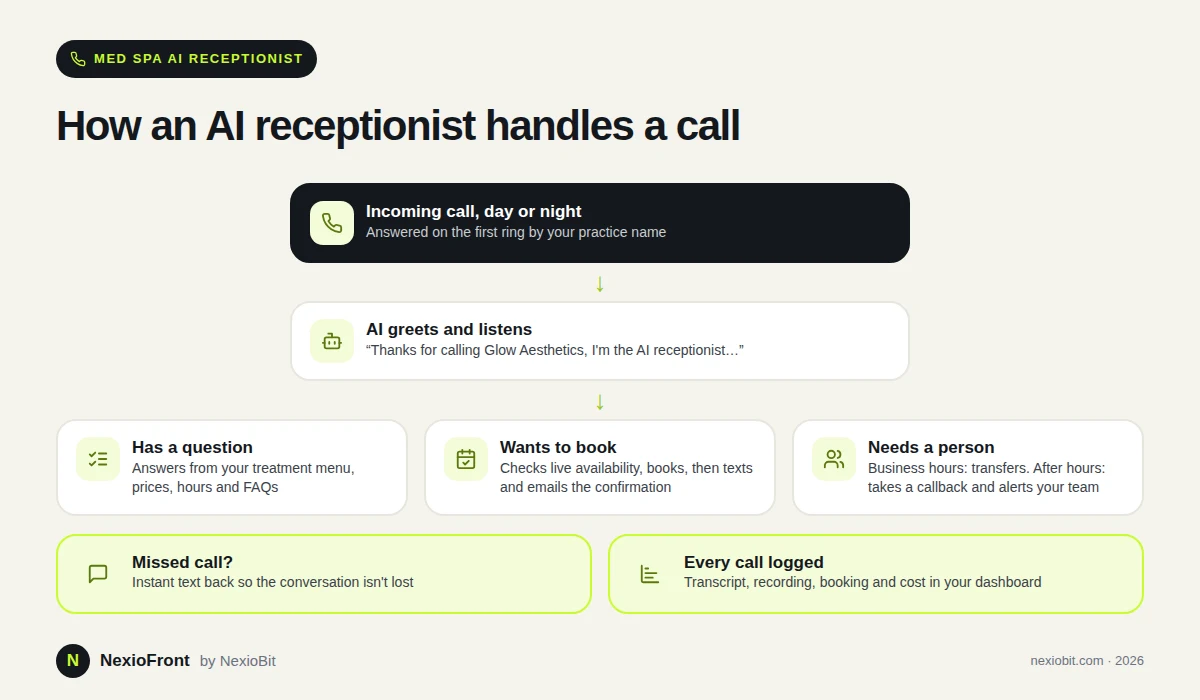
Every call is picked up by your practice name (“Thanks for calling Glow Aesthetics”), and the assistant says it’s an AI, even at 11 PM on a Sunday.
Job 02Answer from your real menu
Treatments, starting prices, durations, hours and FAQs come from your own settings, not generic internet answers.
Job 03Check availability and book
It checks open slots against your hours and closures, books the consultation, and sends the confirmation by text and email.
Job 04Reschedule and cancel
Patients can move or cancel an appointment without waiting on hold, and your calendar updates straight away.
Job 05Hand off to your team
During business hours it transfers to a person. After hours it takes a callback request and alerts your team by email and text.
Job 06Follow up by text
Missed calls get an instant text back, and callers can get a follow-up text so the conversation continues.
Meet NexioFront: the AI voice receptionist built for med spas
NexioFront is the AI voice receptionist we built specifically for med spas. It answers your phone line, books into your calendar and hands off to your team, and it’s part of a complete front-desk system with booking, reminders, reviews and payments included. It runs on Vapi’s voice infrastructure and installs on your WordPress site.
What it does on every call
- Answers on your number, 24/7, by your practice name, and says it’s an AI assistant.
- Knows your menu: services, prices and durations from your NexioFront service list.
- Books live: checks your hours, closures and open slots, then books and confirms by text and email.
- Reschedules and cancels existing appointments, with confirmation texts.
- Transfers or takes callbacks: business-hours transfers; after hours, callback requests with instant staff alerts.
- Voicemail and text-back: voicemail fallback with transcription, missed-call text-back and an optional post-call text.
- Connects to your stack: Google Calendar, GoHighLevel, Stripe deposits, reminders, review requests and multi-location routing.
Inside the NexioFront dashboard
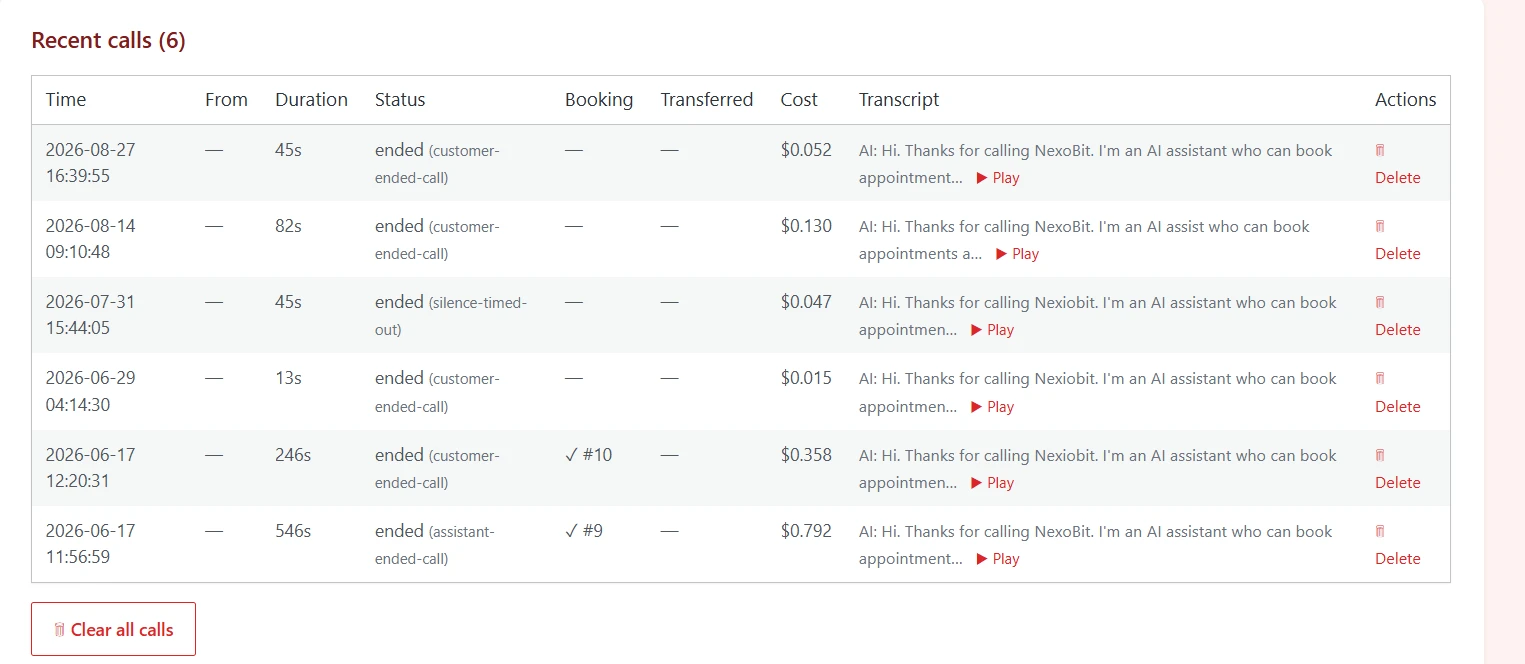
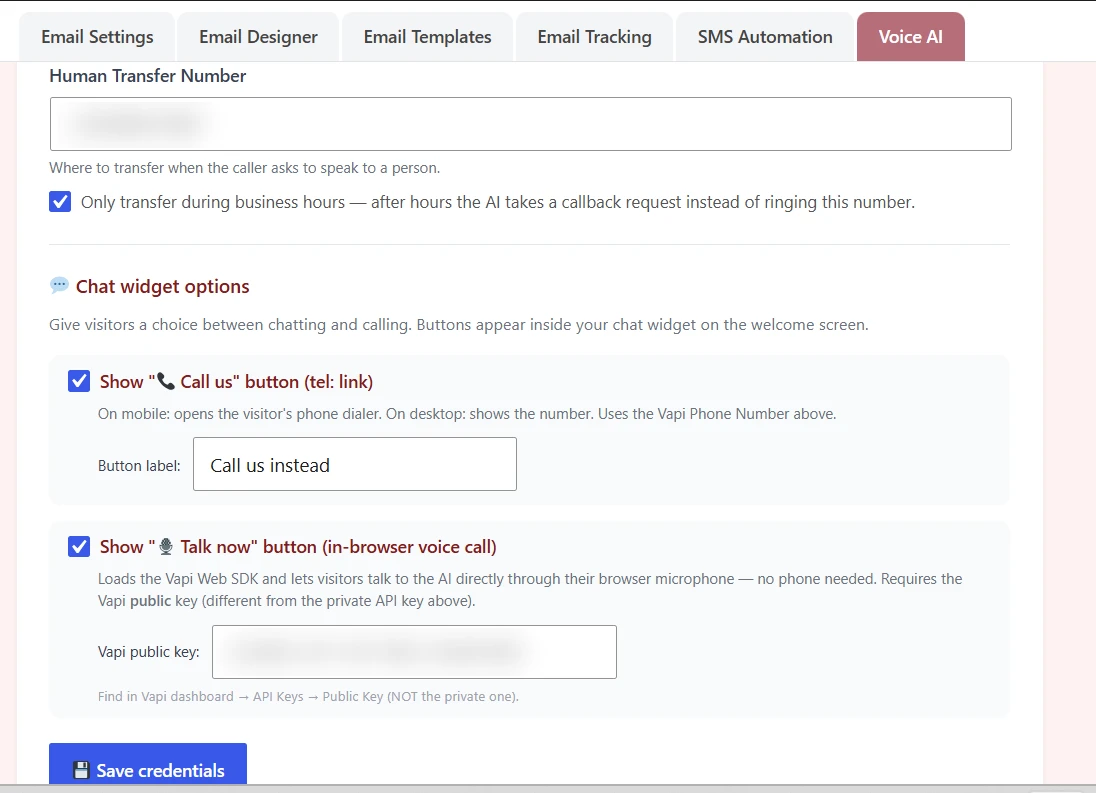
Click below and talk to our AI receptionist through your browser. Ask about a treatment, ask for a time, or ask for a person. It takes about a minute.
Free, right in your browser. Allow microphone access when asked.
AI receptionist options for med spas, compared
When med spa owners ask “what is the best AI phone answering service for a med spa?” or compare an AI answering service for med spas against a human one, the honest answer depends on how much you want to build and maintain yourself:
| NexioFront | Build it yourself (Vapi / Retell) | GoHighLevel AI Employee | Human answering service | |
|---|---|---|---|---|
| Answers 24/7 | ✓ Yes | ✓ Yes | ✓ Yes | Depends on plan |
| Knows your treatments & prices | ✓ From your service menu | If you build it | If configured | Script only |
| Books into your calendar | ✓ Yes | Custom integration | ✓ GHL calendar | Rarely |
| Reschedules & cancels | ✓ Yes | Custom build | Depends on setup | Sometimes |
| Transfers & after-hours callbacks | ✓ Yes | If you build it | ✓ Yes | ✓ Yes |
| Missed-call text-back | ✓ Yes | Separate tool | ✓ Yes | No |
| Setup | Guided, med spa presets | Developer project | Inside GoHighLevel | Script onboarding |
| Who maintains it | NexioBit + your team | You or your developer | You or your agency | The service |
Capabilities of other options vary by plan and setup. Check current features with each vendor.
Building your own on Vapi or Retell gives full control, but you’ll need to connect the calendar, write the tools, handle webhooks and keep it maintained. GoHighLevel’s AI Employee is a solid choice if your whole business already runs in GHL. NexioFront is for med spas that want a voice agent built for aesthetics, set up for them and connected to their booking system.
How much does an AI receptionist cost?
AI receptionist pricing is made of four parts. Comparing vendors on the per-minute rate alone misses most of the picture:
- Voice usage: usually billed per minute of talk time, typically from a few cents up to around 20 cents a minute depending on platform, voice and AI model.
- Phone number: a local or toll-free number usually costs a dollar or two a month.
- Setup: loading treatments, prices, hours and FAQs, connecting the calendar and test-calling it.
- Ongoing tuning: reviewing calls and improving answers, especially in the first month.
For most single-location med spas, the running cost is a small fraction of a front-desk salary. NexioFront pricing depends on how many locations and phone lines you have, so we walk through it on a short setup call rather than publishing one number that won’t fit most clinics.
Is an AI receptionist worth it? Run your numbers
The question isn’t what the AI costs; it’s what unanswered calls cost you now. Enter your own numbers:
If the yearly number is larger than a few months of an AI receptionist’s cost, it’s worth testing. Count your unanswered calls first: most phone systems and Google Business Profile call reports show them.
Can you build your own AI receptionist?
Yes. If you’re technical, or have a developer, you can build one on a voice platform. Here’s what’s involved:
- Pick a voice platform such as Vapi or Retell for the phone line, voice and AI model.
- Write the script and tools: prompts plus functions for availability, booking, rescheduling and transfers.
- Connect your calendar and CRM with webhooks, so bookings land in your real schedule.
- Test and maintain it: call it dozens of times, fix edge cases, and update it when prices or hours change.
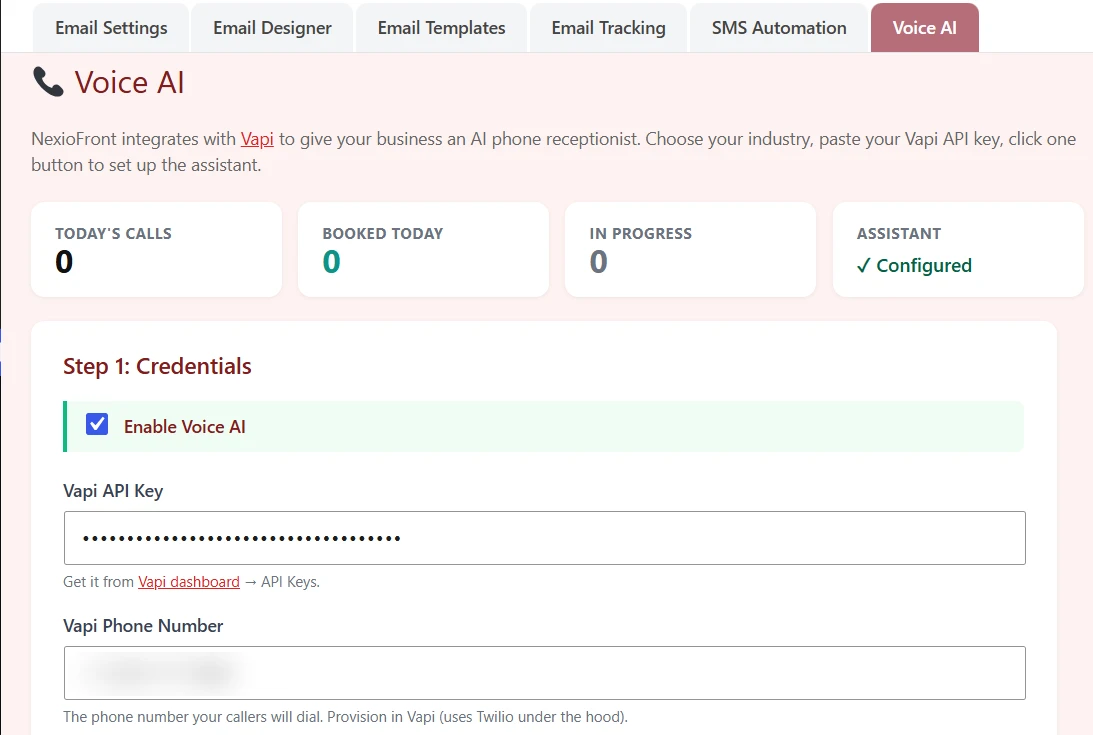
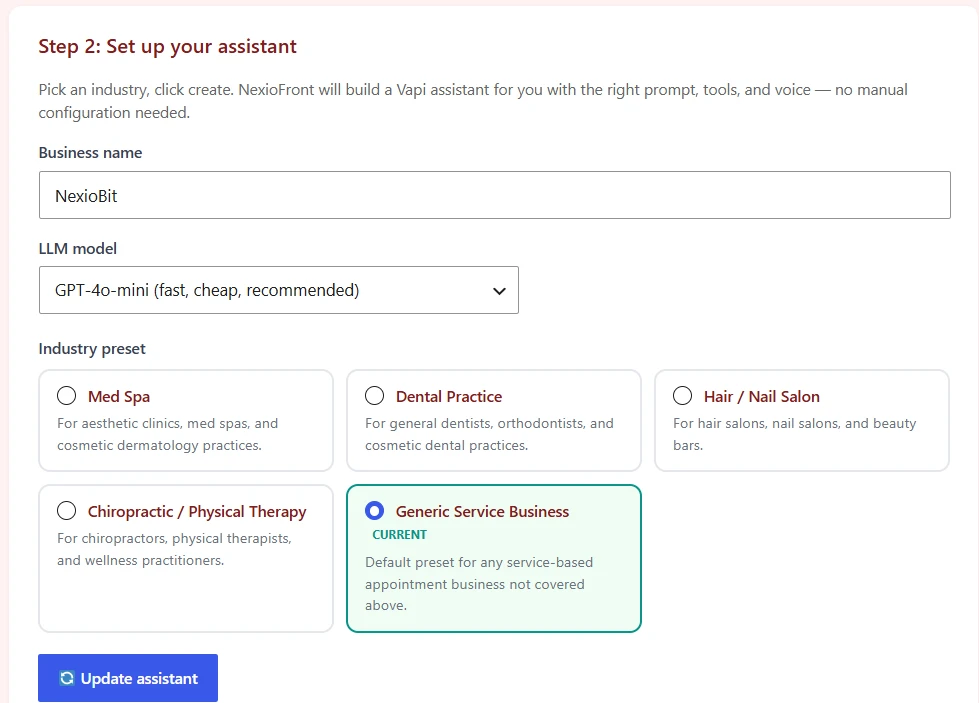
With NexioFront, most of that is already done. You pick the Med Spa preset, connect your Vapi account, and NexioFront creates the assistant with the booking, rescheduling, FAQ and transfer tools already wired to your NexioFront calendar. The work that’s left is the part only you can do: making sure your services, prices, hours and FAQs are accurate, then test-calling it before going live.
HIPAA and compliance: 6 questions to ask any AI receptionist vendor
An AI receptionist at a med spa will hear health information, so treat it like any other system that touches patient data. Ask every vendor these six questions, including us, and get the answers in writing:
- Will you sign a BAA? You need a Business Associate Agreement with the voice platform and the AI model provider if patients discuss treatments or health details.
- How are calls recorded and disclosed? Where recordings are stored, who can access them, and whether callers are told the call is recorded (required in many states).
- Does it say it’s an AI? Some states require AI disclosure, and it builds trust.
- How does it verify identity? Before discussing or changing an appointment, it should confirm the caller really is that patient.
- What happens in an emergency? Post-treatment complications or allergic reactions must be escalated to a person or 911, not booked as a consultation.
- Does it respect text opt-outs? Follow-up texts must honor STOP requests to stay on the right side of TCPA rules.
Mistakes to avoid when launching an AI receptionist
- Trying to sound human. Patients accept an AI that says it’s an AI. They feel misled by one that pretends not to be.
- No path to a person. The assistant must hand off medical questions, complaints and emotional calls.
- Launching without testing. Call it yourself 20–30 times with real questions, odd requests and interruptions before patients do.
- Stale information. If prices, hours or treatments change and the menu isn’t updated, the AI confidently gives old answers.
- Not reading the transcripts. Review a handful of calls every day for the first month and fix the gaps you find.
Is your med spa ready for an AI receptionist?
- “Calls go to voicemail or go unanswered.” This is the strongest reason to start. An AI receptionist pays off fastest here.
- “Our treatment menu and prices aren’t written down.” Do that first. The AI can only be as accurate as the information you give it; it’s usually an afternoon’s work.
- “Bookings live in several places.” NexioFront includes booking and syncs to Google Calendar and GoHighLevel, so this is easy to solve.
If the first one sounds like you and you can handle the other two, you’re ready. Your NexioFront setup call covers the rest.
AI receptionist questions med spa owners actually ask.
Straight answers to the questions I hear most about AI voice agents for aesthetic practices.
What is an AI receptionist for a med spa?
An AI receptionist is an AI voice agent that answers your med spa’s phone calls like a trained front desk. It greets callers by your practice name, answers questions from your treatment menu, checks availability, books consultations and hands off to your team when a person is needed, 24/7.
How much does an AI receptionist cost?
Costs combine per-minute voice usage (typically a few cents up to around 20 cents a minute), a phone number (a dollar or two a month), setup, and ongoing tuning. NexioFront pricing depends on your number of locations and phone lines, so we cover it on a short setup call.
Is an AI receptionist worth it?
It’s worth it when you’re missing calls. Multiply your unanswered calls by the share who wanted to book and your average visit value; the calculator in this guide does the math. For most med spas that miss even a few booking calls a week, the recovered revenue is well above the cost.
Can I create my own AI receptionist?
Yes. You can build one on a voice platform like Vapi or Retell, but you’ll need to write the script, build tools for availability and booking, connect your calendar and maintain it. NexioFront comes with those pieces already built for med spas.
What is the best AI phone answering service for a med spa?
The best option is the one that books into your real calendar, knows your treatment menu, and hands off to your team cleanly. Compare options on those points, and ask every vendor about BAAs, call recording and emergency handling.
Which med spa software has built-in AI features?
Some med spa platforms now include AI for messaging or scheduling. NexioFront is built around an AI voice receptionist that answers calls and books directly, alongside reminders, reviews and payments. See our med spa software comparison for other platforms.
How do I set up voice AI for my med spa?
With NexioFront: choose the Med Spa preset, connect your Vapi account, add your services, hours and FAQs, then test-call it before going live. We handle the setup with you on a call.
Abubakar Nazir
Founder & Principal · NexioBit
I run NexioBit, an AI-powered marketing agency that works exclusively with US medical spas, and I built NexioFront, the AI voice receptionist that answers med spa phone calls. If you want to know whether an AI receptionist makes sense for your practice, I’ll walk you through it personally on a 30-minute call, honest either way.
More about NexioBitTalk to an AI receptionist built for med spas.
Ask it about a treatment, ask for a time, or ask for a person. Then book a setup call and we’ll show you how it would work with your menu, hours and calendar.
Free, right in your browser. Allow microphone access when asked.