How to Choose a Med Spa Marketing Agency in 2026: 7 Questions to Ask
Most agency-selection guides are written by agencies recommending themselves. This one is written for the medspa owner sitting across the table, deciding which agency to hire. Real questions to ask, real red flags, real pricing.
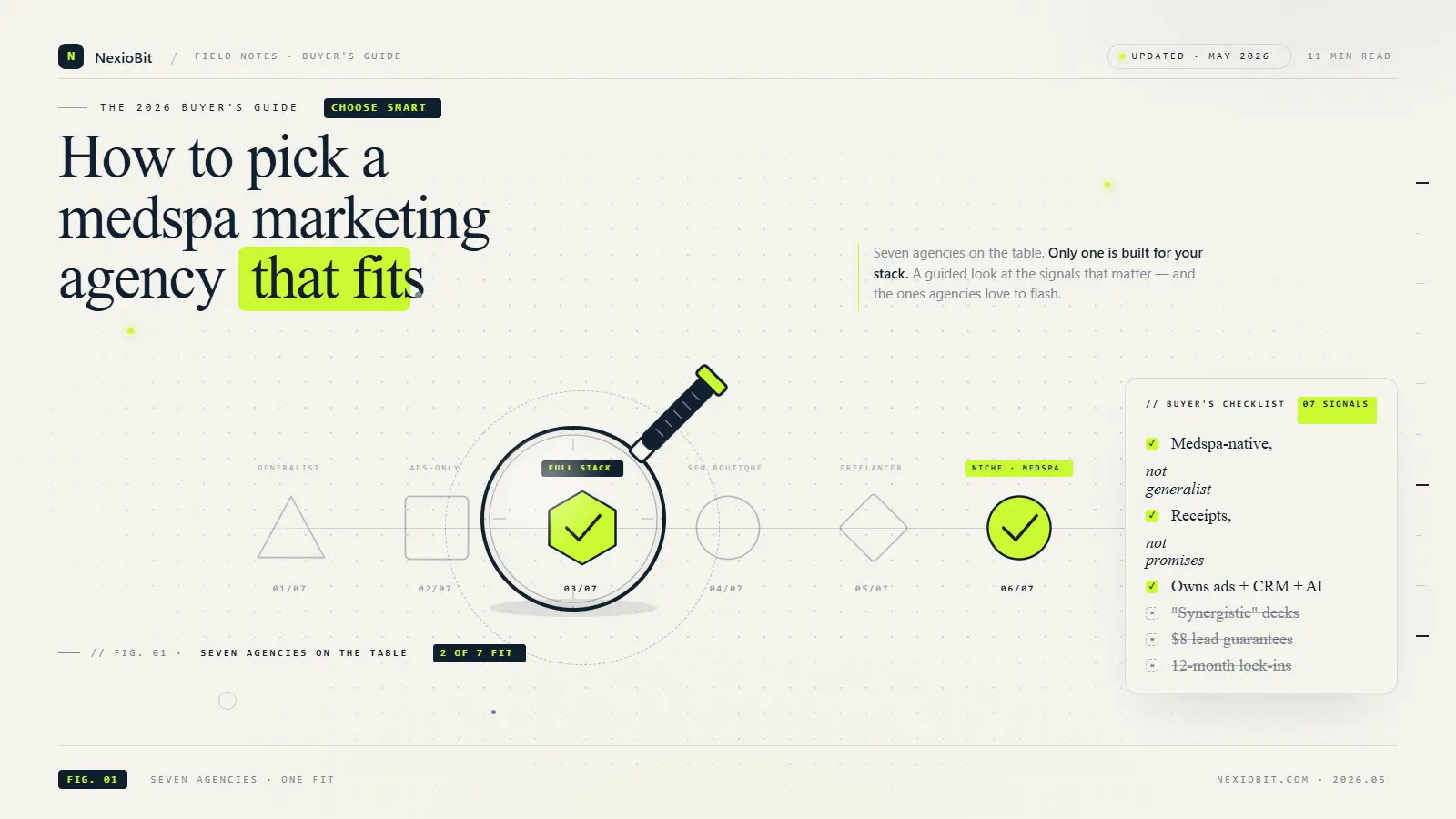
Most medspa owners pick a marketing agency based on the wrong signals: who has the prettiest portfolio, who promises the lowest CPL, or who’s loudest on Instagram. None of those predict whether the relationship will actually grow your practice.
The seven questions in this guide do. They’re the questions I’d ask if I were on the buyer’s side of the table. If an agency can’t answer them clearly and in writing, walk away. Plus realistic pricing, red flags, and how to evaluate the engagement at 30, 60, and 90 days.
Why most agency-selection advice is written by agencies
Google “how to choose a med spa marketing agency” right now. Most of the top results are agency websites with a thin “here’s how to evaluate us” section that conveniently lists every criterion they happen to meet. The independent listicles are usually paid placement or affiliate-driven.
We’re an agency too. So why trust this guide? Because the questions below cost us real money. If you ask them, plenty of agencies fail. We’ll happily answer all seven on a call. Many won’t. That’s the filter.
Picking the wrong marketing agency costs more than picking the wrong clinical software. Bad software wastes $300 per month. A bad agency wastes $5,000 per month plus 6 to 12 months of momentum.
The four types of agencies you’ll encounter
Before the questions, know what you’re looking at. The medspa marketing space breaks into four categories, each with different strengths and limits.
| Type | What they are | Strengths & limits |
|---|---|---|
| Generalist agency | Handles dentists, plumbers, medspas, lawyers in one workflow. | Cheaper, broader reach. Doesn’t know FDA/FTC guardrails, HIPAA, or treatment-specific buyer psychology. Highest churn rate. |
| Vertical specialist (medspa-only) | Works exclusively with medspas or aesthetic practices. | Knows the regulations, the buyer psychology, the platforms. Tends to cost 20 to 40% more than generalists. Worth it for most growing practices. |
| Software-vendor agency | Marketing services bundled with their own platform (Growth99, similar). | Tight platform integration. Conflicts of interest: they can’t recommend competitor tools, even when better. You’re locked into their platform if you leave. |
| Solo consultant or contractor | One person, possibly with a small contractor network. | Direct access, lower cost. Limited capacity. If they get sick or take on too many clients, your account suffers. |
Most growing medspas are best served by a vertical specialist with a small focused team. Generalists are too broad; software-vendor agencies have built-in conflicts; solo consultants hit capacity limits fast.
The 7 questions to ask any med spa marketing agency before signing
Ask all seven. If the answer is hedged, evasive, or “we’ll get back to you,” that’s information.
“Show me a 30-day report from a real medspa client.”
Not a case study deck. Not a screenshot of a top-line revenue number. The actual report: CPL by channel, leads generated, conversion rate, won revenue, attributed to a real practice. Names can be redacted, numbers cannot.
If they show you a polished slide that says “4.2x ROAS” with no underlying numbers, the underlying numbers don’t exist or don’t support the claim.
“Who will I actually work with day-to-day?”
The most common agency pattern: a senior strategist wins the contract, you sign, and you get handed off to a junior account manager who has 15 other clients and can barely remember your practice name. By month three you’re emailing into a void.
The right answer is a named person, accessible by Slack or text or phone, who you’ll talk to weekly. If the founder “personally leads every account” but the agency has 80 clients, that’s mathematically impossible. Press on the math.
“What does the contract look like?”
The contract terms reveal more than the pitch. Three things to check:
- Length. Anything longer than 90 days for a new relationship is a red flag. The agency is locking you in because they can’t earn the renewal on results.
- Cancellation. 30-day notice is standard. Anything longer (60, 90, 180 days) means they’ll keep billing for months after you ask to leave.
- Asset ownership. You should own your ad accounts, your CRM, your domain, your content, your data. If the agency owns any of these on your behalf, you’re a hostage at renewal time.
“How do you handle HIPAA?”
A real answer involves a signed Business Associate Agreement (BAA), explicit data-handling protocols, and a documented stack of HIPAA-configured tools. A wave-of-the-hand “yeah we’re HIPAA-compliant” means they aren’t.
This matters more than most medspa owners realize. If your agency runs marketing through a non-HIPAA-compliant CRM or email tool and a complaint is filed, the liability lands on your practice, not the agency. Industry resources like the American Med Spa Association (AmSpa) have extensive HIPAA-for-medspa guidance worth reading before signing with anyone.
“What’s in scope, and what costs extra?”
The retainer fee is the entry ticket. The real bill includes everything not in scope. Common “out of scope” charges that catch medspas off-guard:
- Landing page builds (often $500 to $2,000 each)
- Video editing or photo shoots
- Email template design
- CRM build and automation setup
- Strategy calls beyond a monthly cadence
- Rush requests or weekend work
Get the scope-of-work in writing before signing. A real agency will hand you a one-page SOW listing exactly what’s in scope and the hourly rate for anything outside it.
“What’s your honest opinion of my current setup?”
This is the test most agencies fail. A good agency will look at your website, ads, GBP, and reviews before the call and give you specific, useful feedback. Two or three real observations. Not flattery, not generic talking points.
The follow-up: ask what they’d fix first, and why. If their answer is “sign up and we’ll find out together,” they don’t know yet because they haven’t looked. If their answer is detailed and specific, they’ve done the work.
“What does offboarding look like if it doesn’t work out?”
The question agencies hate. Ask it anyway.
The right answer is detailed: data export procedures, account ownership transfer, content handoff, what timeline. If they don’t have a process, they’ve never had to do it cleanly. If they have a process and explain it, they respect your right to leave.
Bonus signal: a good agency will tell you upfront what scenarios would lead them to fire you as a client. Specialists do this. Generalists rarely do.
What med spa marketing actually costs
The pricing range I share with medspa owners on discovery calls, based on what I see across real engagements:
| Practice profile | Realistic monthly retainer | Plus ad spend |
|---|---|---|
| New / under $30K/mo revenue | $1,500 to $3,000 | $1,500 to $3,000 |
| Single-location, $30K to $80K/mo | $2,500 to $4,500 | $3,000 to $6,000 |
| Single-location, $80K to $150K/mo | $3,500 to $7,500 | $5,000 to $10,000 |
| Multi-location or premium | $5,000 to $12,000 | $8,000 to $20,000+ |
Two honest caveats:
- Below $1,500/month retainer, no agency can deliver real work. If someone quotes $799/month all-in, they’re selling templated work that won’t move your numbers, or hiding ad spend that gets billed separately.
- Above $10,000/month retainer for a single location, you’re paying for capabilities you won’t use. That budget makes sense for multi-location operators or practices doing $200K+/month.
These are agency retainer numbers. Platform costs are separate. The marketing platform alone (we deploy GoHighLevel, see our full pricing breakdown for medspas) runs $97 to $497 per month plus usage-based add-ons. Factor that in when comparing all-in monthly investment.
Red flags that mean walk away (no questions needed)
Some signals don’t require the seven questions. If any of these show up early, save yourself the discovery call:
- Guarantees of specific outcomes (“guaranteed 20 leads/month,” “we guarantee page 1 in 30 days”). No reputable agency guarantees outcomes they don’t control. They guarantee inputs (work delivered) or process, not outputs.
- Aggressive sales tactics (multiple follow-up calls, “sign by Friday for a discount”). Good agencies don’t need to pressure-close because they’re not desperate.
- Pricing wildly out of line with the table above in either direction. Too cheap means corner-cutting; too expensive without a multi-location or premium scope means they’re testing you.
- No vertical focus. “We work with medspas, dentists, lawyers, and gyms.” The playbook doesn’t transfer cleanly. Hire a specialist.
- No real client they’ll let you reference. Every legitimate agency has a few clients who’ll take a 10-minute call. If none will, that’s the answer.
- Stock photo headshots on the team page. If they’re willing to fake their own team, what else are they faking?
How to evaluate the engagement at 30, 60, and 90 days
Once you’ve hired someone, the 90-day window is the honest test. Check at each milestone:
- Day 30 check Onboarding complete: BAA signed, accounts handed over, baseline metrics documented, first campaigns or workflows live. If onboarding isn’t done by day 30, that’s a problem.
- Day 60 check You should see lead volume from new campaigns and first measurable lift in at least one channel. Not necessarily revenue lift yet, but leads in the pipeline. If month 2 looks like month 0, the agency is not executing.
- Day 90 check Real revenue impact should be visible. Either booked consults attributable to the agency’s work, or measurable conversion lift on existing traffic. By day 90 the math should be obvious. If you have to squint to see whether the agency is working, the answer is no.
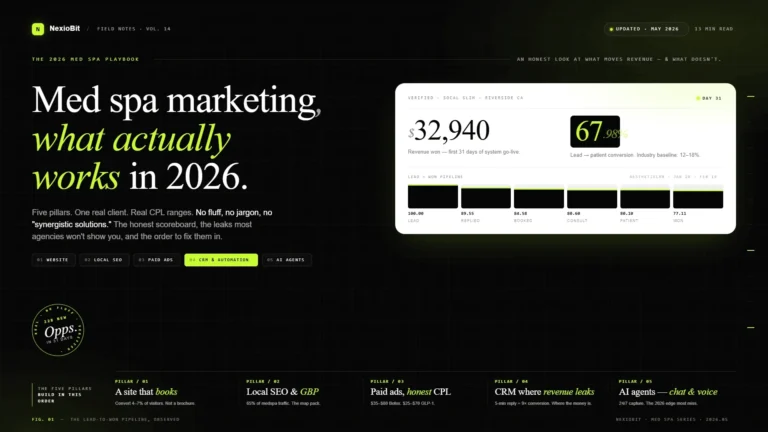
A real engagement looks like this: one of our clients (SoCal Slim in Riverside, CA) went from zero to $32,940 in won revenue, 228 opportunities, and 67.98% lead-to-patient conversion in 31 days. That’s a real 30-day result. If your agency can’t describe what month-one success looks like in concrete numbers, they don’t have a plan, they have a hope.
What to do next
Two paths from here.
If you’re evaluating agencies right now: use the seven questions and the red flag list as your filter. Most agencies will eliminate themselves in the first two or three answers. The ones left are worth a deeper conversation.
If you’re wondering whether you even need an agency yet: read our five-pillar med spa marketing playbook first. Some practices don’t need an agency, they need a marketing operator. Some need both. Some need neither yet. The playbook helps you figure out which one you are.
If AI voice and automation will be part of the engagement: ask any agency you interview to walk you through their deployment process. Our complete guide to AI voice agents for medspas covers what a real build looks like, platform comparisons (Retell, Vapi, GoHighLevel AI Employee), and the four readiness conditions before deployment.
The agency questions medspa owners actually ask me.
Direct answers to the six questions I hear most from medspa owners during their agency search.
How much does a med spa marketing agency cost?
Realistic monthly retainers run $1,500 to $12,000 depending on practice size, plus ad spend. New medspas (under $30K/month revenue) sit at $1,500 to $3,000 retainer plus matching ad spend. Single-location practices doing $80K to $150K/month typically land at $3,500 to $7,500 retainer plus $5,000 to $10,000 ad spend. Anything under $1,500/month all-in retainer is templated work that won’t move your numbers.
What questions should I ask a med spa marketing agency before signing?
Seven core questions: (1) Show me a 30-day report from a real medspa client; (2) Who will I actually work with day-to-day; (3) What does the contract look like (length, cancellation, asset ownership); (4) How do you handle HIPAA and the BAA; (5) What’s in scope and what costs extra; (6) What’s your honest opinion of my current setup; (7) What does offboarding look like if it doesn’t work out. Each one tests something different. Hedged answers on any of them are useful information.
Should I hire a generalist agency or a med spa specialist?
A specialist, in almost every case. Generalist agencies that handle dentists, plumbers, and medspas don’t know the FDA/FTC guardrails, HIPAA configuration requirements, or treatment-specific buyer psychology. The playbook doesn’t transfer cleanly across industries. Vertical specialists cost 20 to 40% more, and they’re worth it for any practice past the brand-new stage. Avoid software-vendor agencies (Growth99 and similar) because they have built-in conflicts of interest with their own platform.
How long should a med spa marketing agency contract be?
A reasonable initial term is 90 days, then month-to-month. The 90 days gives the agency time to onboard, build, and show real results. Month-to-month after that means they earn the renewal on performance. Anything longer than 90 days for a new relationship is a red flag. Twelve-month minimum contracts exist because the agency knows you wouldn’t renew voluntarily.
What should I expect in the first 30 days with a new marketing agency?
Onboarding complete: BAA signed, ad and CRM accounts handed over to your ownership, baseline metrics documented, first campaigns or automation workflows live, weekly cadence established. By day 30 you should also have a written 90-day plan with specific milestones. If onboarding is still incomplete at day 30, that predicts how the rest of the engagement will go. For reference, one of our recent client builds produced 228 opportunities and $32,940 in won revenue in the first 31 days, so meaningful results in month one are achievable when the infrastructure is right.
What are the biggest red flags when hiring a med spa marketing agency?
In order of how often they predict failure: guaranteed-outcome promises (real agencies guarantee inputs, not outputs), generalist positioning (medspas, dentists, gyms in one workflow), 12-month minimum contracts, vague scope-of-work, agency-owned ad accounts, no real client they’ll let you reference, stock photo headshots on the team page, and aggressive sales tactics like “sign by Friday for a discount.” Any one of these is a yellow flag; two or more is walk-away territory.
Abubakar Nazir
Founder & Principal · NexioBit
I run NexioBit, an AI-powered marketing agency that works exclusively with US medical spas. We’d answer all seven of the questions above in writing, on a call, before you sign anything. If you want to put us through that filter, that’s a free 30-minute conversation. No sales rep, no slides, no pressure.
More about NexioBitPut us through the 7 questions.
30-minute call. I’ll answer all seven questions in this guide on the record. I’ll also tell you the two specific fixes I see in your current funnel before we talk about hiring anyone. Free if it doesn’t help; honest either way.
Book my 30-minute call