How to Open a Med Spa in 2027: The Step-by-Step Guide
Who can legally own one, what it really costs, a month-by-month timeline, and the marketing most guides leave until it’s too late. Written for nurses, NPs, PAs, doctors, estheticians and investors opening in the US. Real numbers, no demo request at the end.

To open a med spa in the US: confirm who can own one in your state (often through an MSO if you’re not a physician), sign a medical director, write a business plan with four to six months of costs in reserve, form your company and get licensed and insured, build out your space, pick a focused launch menu, hire your injector and front desk, set up booking and phones, and start marketing 90 days before you open.
Plan for 6 to 12 months and anywhere from about $45,000 (solo, renting a room) to $450,000+ (multi-room with lasers). The legal steps decide whether you can open. The marketing steps decide whether anyone shows up.
Why most “how to open a med spa” guides leave you short
Search how to open a med spa right now and look at who wrote the results. Most are software companies, an equipment seller, a booking platform. Each guide is useful in places, and each one quietly ends in a demo request. That’s why the hard parts get a paragraph apiece: who’s actually allowed to own the business, what happens to your cash in the first six months, and how patients find a med spa nobody has heard of yet.
I run a marketing agency that works only with US med spas. I’m not a lawyer, and I won’t pretend to be one. What I do see, over and over, is new owners who get the legal side right and then open to a quiet calendar, because the Google listing, the booking link and the phone setup were left for “after we open.”
A med spa can be fully licensed and still fail in month five. The legal steps decide whether you can open. The marketing steps decide whether you can stay open.
So this guide covers the legal and money steps in the order that avoids expensive do-overs, then spends real time on the part I know best: opening with patients already booked.
1. Decide what kind of med spa you’re opening
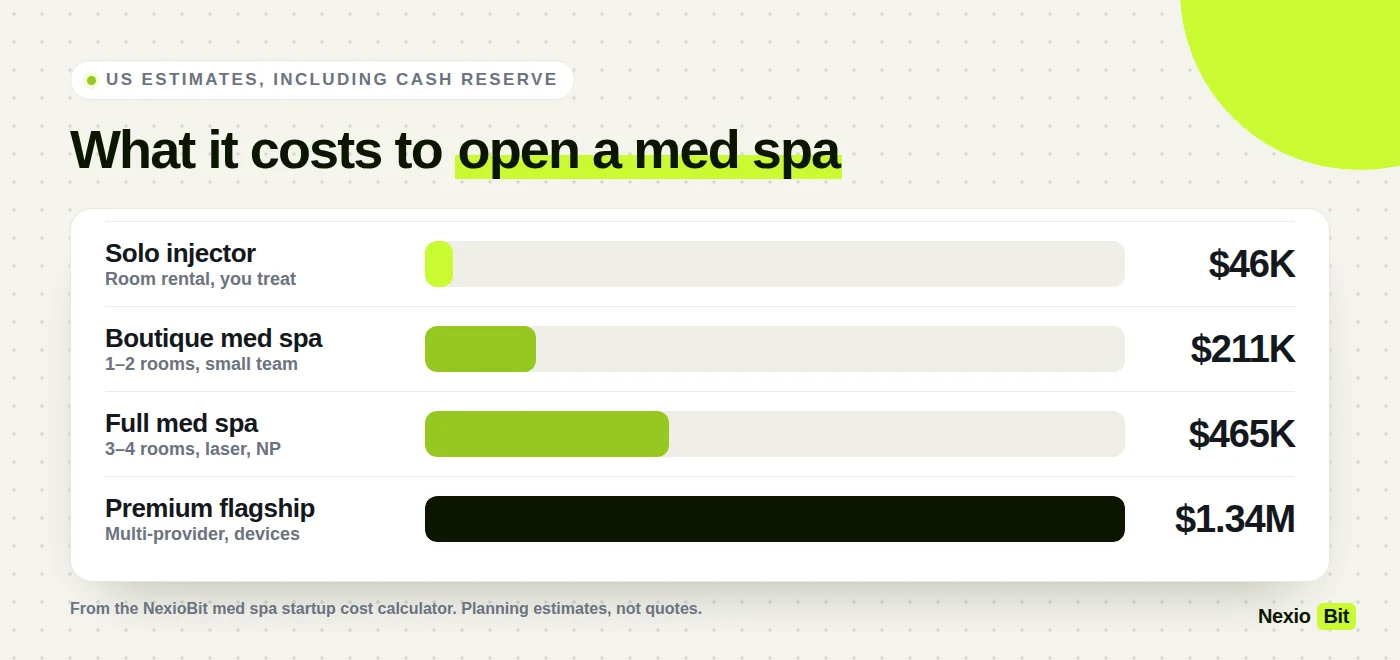
Before you call an attorney or tour a single space, decide the size of the thing you’re building. Almost every later decision depends on it: how much space you need, whether you hire an injector or treat patients yourself, which devices make sense, and how much cash you need to raise.
| Model | What it looks like | Typical cash to open |
|---|---|---|
| Solo injector | An NP or RN renting a treatment room or suite and treating patients themselves. Injectables and simple skin treatments, no big devices. | $40K to $70K |
| Boutique med spa | One or two treatment rooms, one entry-level device, a front desk person and an aesthetician. | $180K to $300K |
| Full med spa | Three or four rooms, a laser, an employed NP injector, a bigger launch budget. | $400K to $600K |
| Premium flagship | Multiple providers, several devices, a prime retail location. | $1M+ |
If you’re unsure, the solo or boutique model is the safer start. You can add rooms and devices once patients ask for them. It’s much harder to shrink a lease and a laser payment you signed for on day one.
Run your own numbers
Pick a model, change any cost, and see your cash to open, break-even month and how long your reserve lasts.
2. Who can own a med spa? Your license decides the path
Anyone working out how to open a med spa should start here, and it’s where most guides go vague. In most states, injecting neurotoxins, using lasers and deciding what a patient needs count as the practice of medicine. Many states also follow the corporate practice of medicine doctrine, which limits who can own a business that delivers medical care.
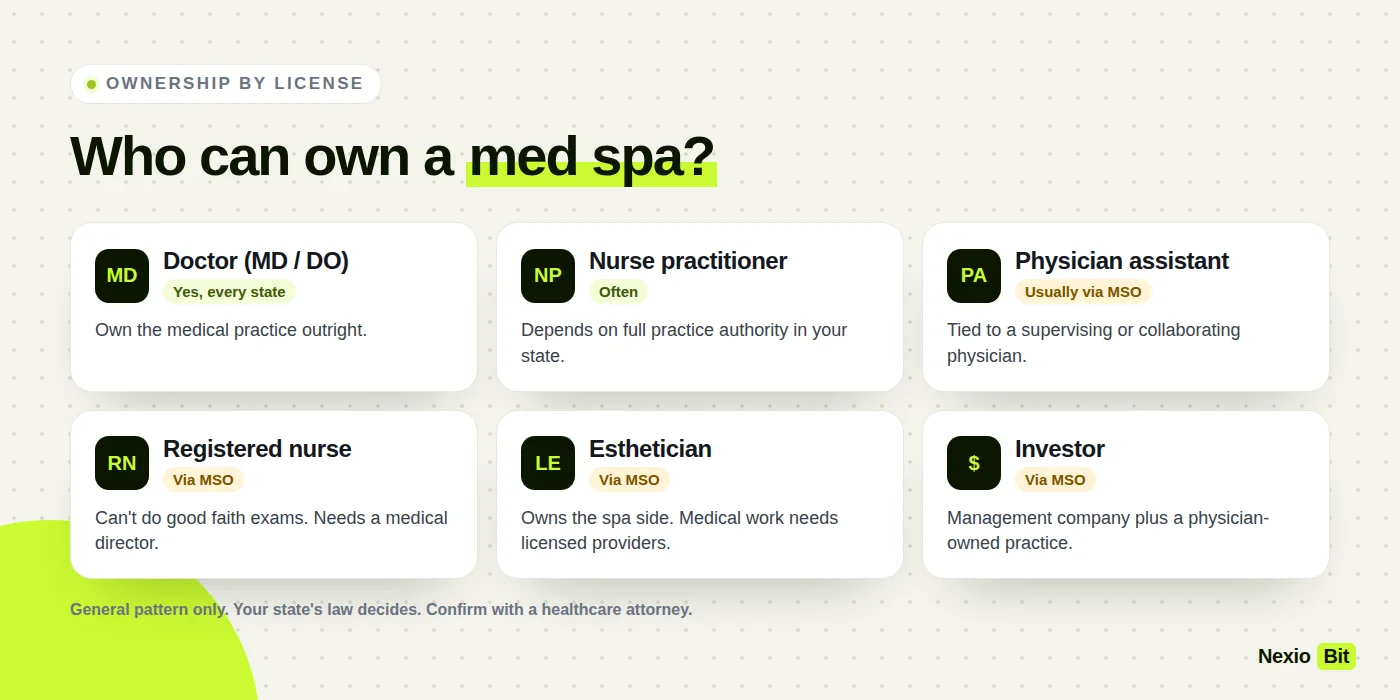
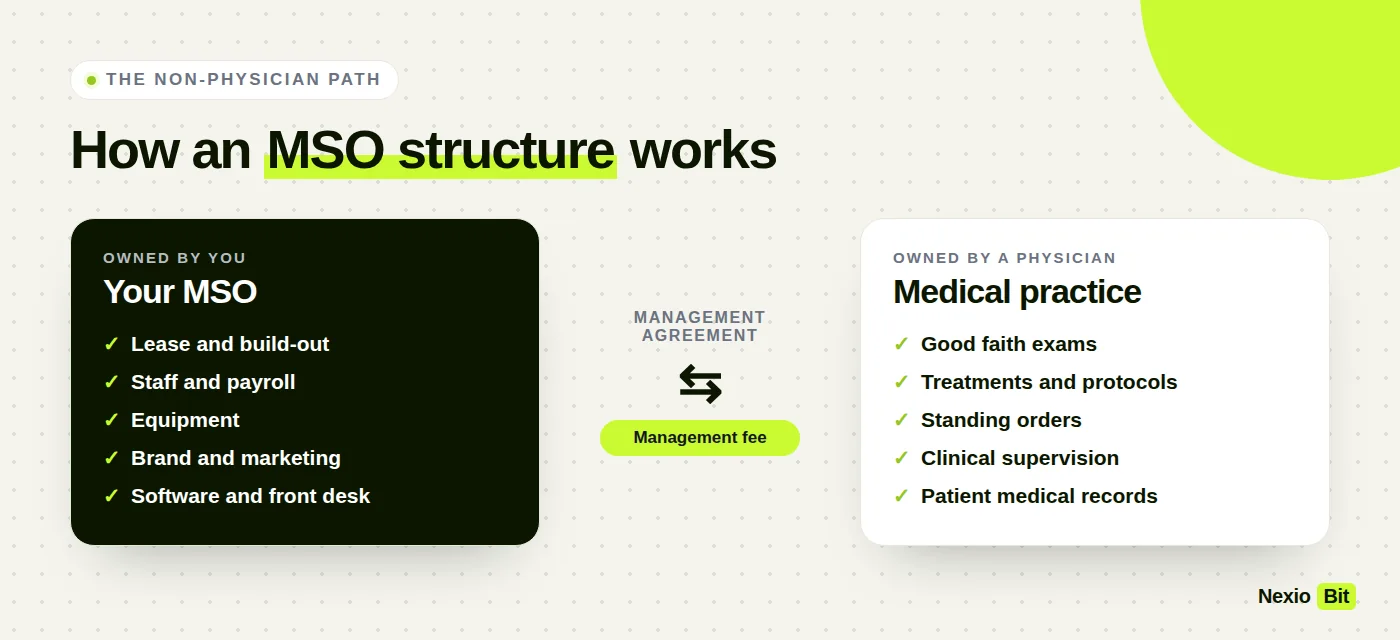
If you’re not a physician, the common route is a two-company setup. You own a management services organization (MSO) that holds the lease, staff, equipment, brand and marketing. A physician, or in some states another eligible provider, owns the medical practice that delivers treatments. The MSO charges the practice a management fee. How that fee is set is regulated, which is one reason this is attorney work, not a template you download.
Then there’s the good faith exam, the first assessment that decides whether a patient is a good candidate for treatment. The American Med Spa Association (AmSpa) is clear that only an MD, DO, NP or PA can perform it, and an RN who does it risks being charged with practicing medicine without a license.
| If you are a… | Can you own it? | What you’ll usually need |
|---|---|---|
| Doctor (MD or DO) | Yes, in every state. | Written protocols and supervision plans for your staff, plus malpractice cover. The legal side is easiest for you; the business side is where many physician-owned med spas struggle. |
| Nurse practitioner | Often, in states with full practice authority. Elsewhere you’ll need a collaborating or supervising physician, possibly an MSO. | You can perform good faith exams. Check your state’s NP practice rules and ownership rules separately; they’re not the same thing. |
| Physician assistant | Usually not on your own. Most states tie PA practice to a supervising or collaborating physician. | An MSO or a physician partner. You can perform good faith exams. |
| Registered nurse | Usually not the medical practice itself. You can often own the MSO. | A medical director, plus an MD, DO, NP or PA for exams. You inject only under the delegation your state allows. |
| Esthetician | You can own the spa and often the MSO, but can’t perform or direct medical treatments. | A medical director and licensed injectors. Many start with facials and skin services, then add medical treatments. |
| Non-medical investor | Through an MSO in most states. | A healthcare attorney before you spend money, a medical director, and licensed providers. |
3. Find a medical director who actually shows up
Unless you’re a physician, you’ll need a medical director: a doctor (or, in some states, an NP) who signs your protocols and standing orders, oversees your providers, and takes medical responsibility for what happens in your rooms. Good places to look are physicians you already work with, local dermatologists and plastic surgeons, emergency and family medicine doctors, aesthetic conferences, and medical director matching services.
Monthly retainers are commonly quoted between $1,500 and $5,000, more if the director is on site regularly. The fee matters less than the engagement. Ask these five questions before you sign:
“How often will you review charts, and how many?”
Chart review is the job. A director who never looks at charts can’t catch problems before they become complaints.
“Can my team reach you for a complication on a Saturday?”
Complications don’t keep office hours. Your injector needs a phone number that gets answered, and a named backup when the director is away.
“Will you train and sign off on new injectors?”
Every new provider should be checked on technique and protocols before treating patients alone.
“How many other practices do you supervise?”
Some directors supervise dozens of locations. Spread that thin, nobody gets real oversight.
“Does your malpractice coverage include this role?”
Medical director work isn’t always covered by a physician’s standard policy.
4. Write a business plan a bank will actually read
You need a business plan for two reasons: lenders and investors will ask for one, and writing it forces you to find problems on paper instead of in month four. It doesn’t need to be 40 pages. It needs to be specific:
- Concept and launch menu: who you serve and what you offer on day one.
- Local market: open Google Maps, search “med spa near me” from your planned address, and note every competitor within 10 miles, their prices, review counts and ratings. That’s your real competition.
- Startup and monthly budgets: from written quotes wherever possible.
- Ramp and break-even: how many paid visits a month cover your costs, and how fast you’ll get there.
- Funding and a three-year projection, including a pessimistic case.
The break-even line is the one people skip, and it’s the most useful line in the plan.
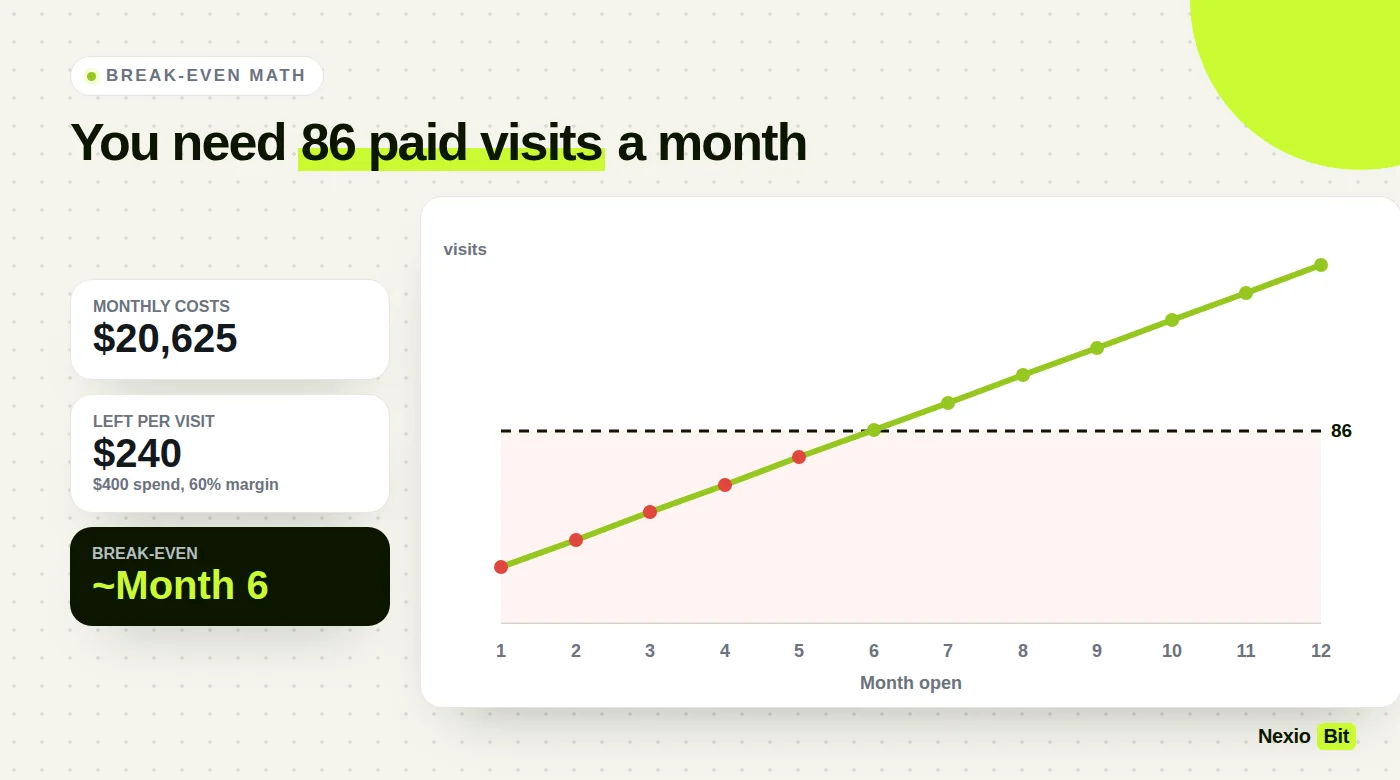
Everything about your launch plan should answer one question: how do we get to 20 paid visits a week as fast as possible?
5. How much does it cost to open a med spa?
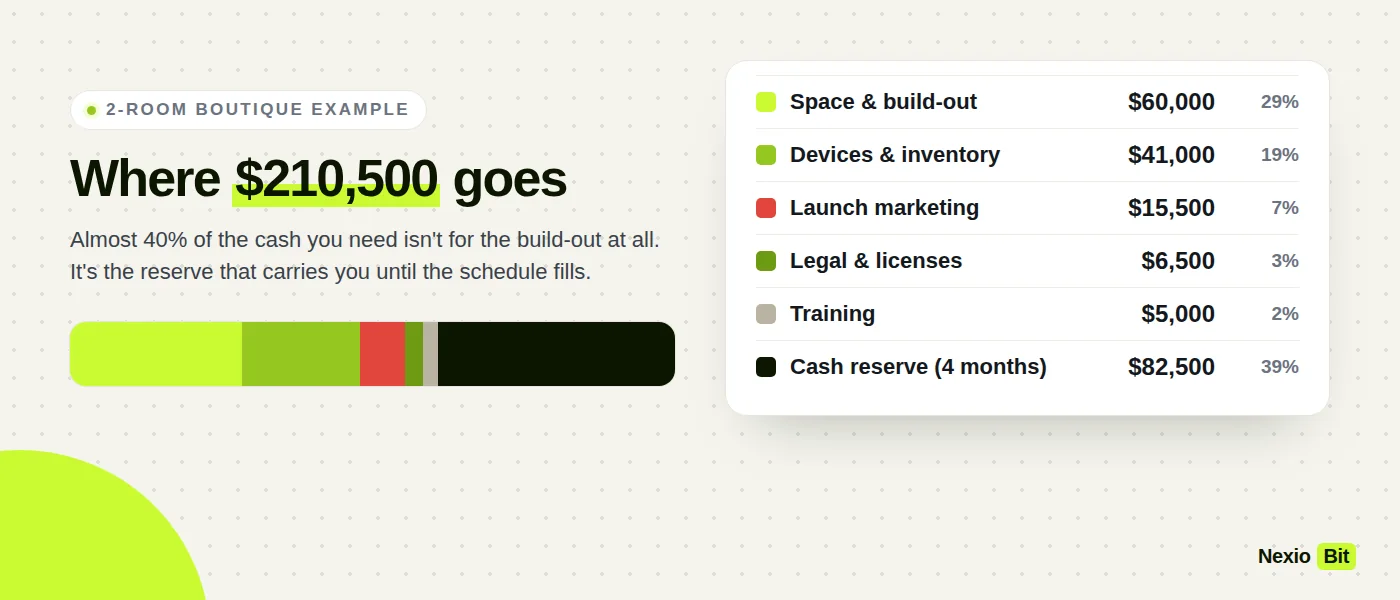
Anywhere from about $45,000 to over $1 million, which isn’t useful on its own. Here’s where the money goes for a two-room boutique, using the same assumptions as our calculator:
| Category | What’s in it | Boutique example |
|---|---|---|
| Space and build-out | Deposit, renovation, plumbing and electrical, furniture | ~$60K one-time, plus rent |
| Devices and inventory | One device or a down payment, opening injectables, retail stock | ~$41K one-time |
| Medical oversight and legal | Medical director, good faith exams, attorney, entity setup, licenses | ~$6.5K + $3K/month |
| Insurance | Malpractice, general liability and property, workers’ comp | ~$7.5K/year |
| Staff | Front desk and aesthetician (owner injects) | ~$7.2K/month |
| Software and phones | Charting, booking, CRM, missed-call text-back | ~$900/month |
| Launch marketing | Brand, website, photos, pre-opening campaign, then SEO and ads | ~$15.5K + $4K/month |
| Cash reserve | Four months of operating costs | ~$82K |
Three things move the total more than anything else:
- Devices. One laser or body-contouring device can cost more than everything else combined. Leasing lowers the upfront cost but adds a payment your early revenue has to cover.
- Build-out. Taking over a former medical or spa space with sinks and treatment rooms in place can save tens of thousands.
- Your reserve. Running out of cash in month five is one of the most common reasons good med spas close. Hold four to six months of operating costs.
Malpractice for an injector is commonly quoted around $2,000 to $5,000 a year, more for lasers and in states with higher claim costs. Get quotes from carriers that specialize in aesthetics before you sign a lease.
6. Licenses, insurance and compliance
Exact requirements vary by state and city, but expect most of this list:
Business setup
- Your entity (LLC, PLLC or professional corporation, plus the MSO if you’re using one) and an EIN
- State and local business licenses, and zoning approval for medical use at your address
- Any facility license or registration your state requires for medical spas
- A sales tax permit if you’ll sell retail skincare
Clinical
- Verified licenses for every provider, and a signed medical director agreement
- Written protocols and standing orders for each treatment
- Informed consent forms, an emergency kit, and a written plan for complications
- OSHA basics: bloodborne pathogens training, sharps disposal, and laser safety if you have lasers
Patient data and marketing
- HIPAA: privacy policies, staff training, and a signed Business Associate Agreement (BAA) with every vendor that touches patient information, including your phone, chat and CRM tools.
- Text consent: under the TCPA, get written consent before sending marketing texts, captured on your intake and booking forms.
- Before-and-after photos: written permission from patients before you post them, and accurate treatment claims. Med spa ads follow the same rules as other medical advertising.
Insurance
- Professional liability for every provider, with your medical director’s role covered
- General liability and property, often bundled as a business owner’s policy
- Workers’ compensation once you have employees
7. Location and build-out
The most expensive mistake in this whole process is signing a lease before you understand your state’s ownership rules and your zoning. A space that can’t legally be used for medical treatments, or a structure that has to change after you’ve signed, can cost you months.
- Visibility and parking close to the people you want to treat. Patients choose convenience more than you’d think.
- Plumbing and electrical for sinks in treatment rooms, a hydrafacial machine, and the power some lasers need.
- Private rooms with doors that close, and a reception area where patients aren’t overheard.
- Accessibility, including ramps or elevators and accessible restrooms.
- Lease terms that allow your use, give you time for the build-out, and don’t lock you into more space than you need.
Not sure about demand? Start with a suite in a salon-suite building or a room inside an existing practice. It’s the cheapest way to prove your market before committing to a full build-out.
8. Choose a launch menu that pays, then buy for it
New owners often open with every service they’ve ever wanted to offer. A narrow, deep menu is easier to staff, easier to market and much cheaper to equip:
- Neurotoxins and fillers, which bring patients back every few months
- One or two skin services, such as chemical peels, microneedling or a hydrafacial
- A professional skincare line patients can reorder between visits
- A membership or package from day one, so first visits turn into monthly revenue
Add devices once patients ask for them and you can see the demand in your bookings. When you do, choose FDA-cleared equipment and price in the full cost: training, consumables, service contracts and warranty, not just the monthly payment.
9. Hire the two roles that make or break you
Your injector drives outcomes, reviews and word of mouth. Hire for judgment and bedside manner as much as technique, and check that their license and experience match what your state allows.
Your front desk decides whether inquiries become appointments. A phone that rings out at 5:45 PM, or a website form that waits until tomorrow, quietly costs more than most lines in your budget. Hire someone warm who follows up, then give them systems that catch what a busy person misses.
On pay, hourly or salary plus a commission or bonus is common for injectors. Some states restrict how medical providers can be paid on commission, so run your compensation plan past your attorney too.
10. Set up your systems before opening day
Your launch marketing creates inquiries immediately, and the med spas that reply first win most of them. Have these working before patient one:
The four systems every new med spa needs
- Charting (EMR)Patient records, consent forms, treatment notes, before-and-after photos.
- Online bookingA patient can book a specific treatment at 10 PM without calling.
- CRM and phoneEvery lead tracked, a reply within minutes, and a text that goes out automatically when a call isn’t answered. Most new med spas skip this one. See how missed call text back works.
- Payments, memberships and reviewsRecurring billing, plus an automatic review request after every visit.
Get a signed BAA from each vendor that stores patient information. If you want the lead, follow-up and review pieces built for you, that’s what our GoHighLevel setup for med spas covers.
11. Start marketing 90 days before you open
Here’s the part most guides save for last. If your first patients find out you exist on opening day, your first month will be slow and your reserve will shrink faster than planned. The work that fills your calendar has to start while the walls are still going up.
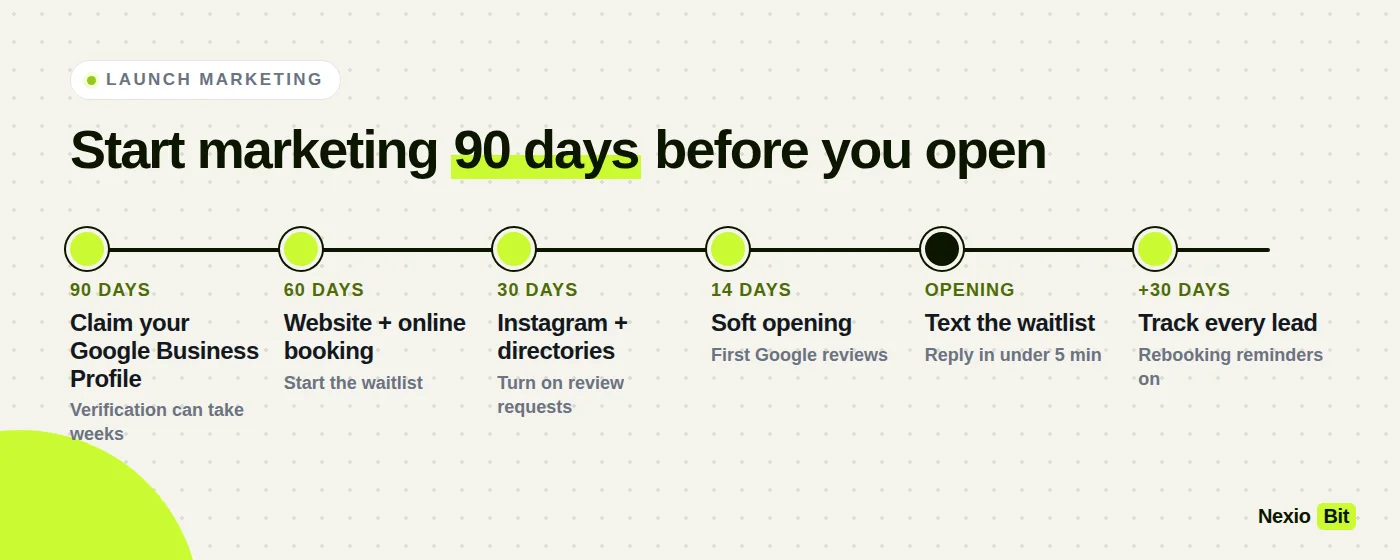
- 90 days before: claim your Google Business Profile with “Medical spa” as the primary category (verification can take weeks), lock in your name, domain and Instagram handle, and set up your phone line with missed-call text-back.
- 60 days before: launch your website with one page per treatment, “starting at” prices and online booking on every page. Start a waitlist with an opening offer, and collect text consent on that form.
- 30 days before: post build-out progress and team intros on Instagram, list yourself on Yelp, Apple Business Connect and Bing with identical details, and turn on automatic review requests.
- 14 days before: run a soft opening for friends, family and waitlist VIPs, ask every guest for a Google review, and test every booking path on a phone, including after hours.
- Opening week: text and email the opening offer to your waitlist, and reply to every call, DM and form within five minutes.
- First 30 days: ask every patient for a review, record where each new patient came from, and turn on rebooking reminders before you spend more on ads.
For most med spas, the Google Business Profile becomes the biggest source of calls. One Tampa med spa we work with got 580 calls from its listing in five months, with no ad spend.
Read the Tampa case study to see what that listing looks like. Still choosing a name? Try our free med spa name generator, and check the .com and Instagram handle before you print anything.
Get your launch timeline
Pick your model in the startup cost calculator and unlock a six-phase pre-opening marketing timeline.
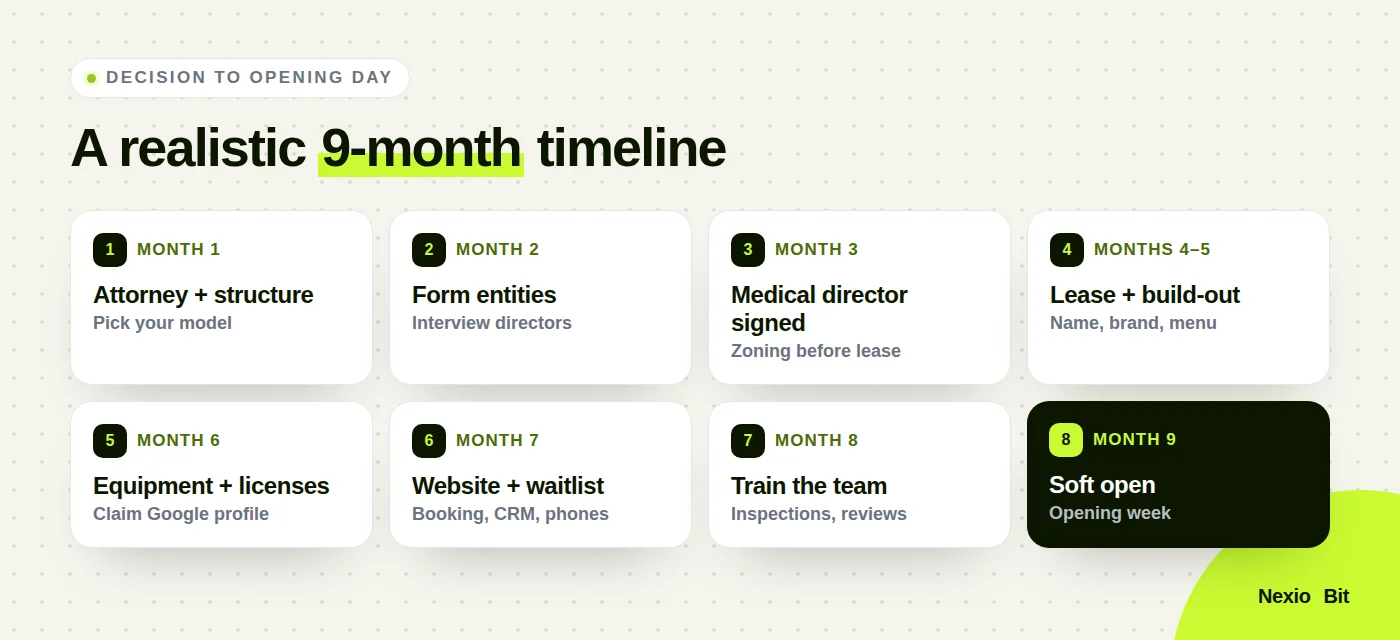
12. A realistic 9-month timeline
If you’re planning how to open a med spa on a deadline, allow six to twelve months from decision to opening. Legal setup, the build-out and licenses are the slow parts.
| When | What gets done |
|---|---|
| Month 1 | Choose your model. Meet a healthcare attorney about ownership and structure. Start the business plan. |
| Month 2 | Form your entities. Interview medical directors. Finalize the plan and apply for funding. |
| Month 3 | Sign the medical director agreement. Tour spaces and confirm zoning before you sign a lease. |
| Months 4 to 5 | Sign the lease and start the build-out. Get insurance quotes. Choose your name, brand and launch menu. |
| Month 6 | Order equipment. Apply for licenses and permits. Claim your Google Business Profile. Start hiring. |
| Month 7 | Launch the website and waitlist. Set up charting, booking, CRM and phones. Write protocols and consent forms. |
| Month 8 | Train the team. Final inspections. Directory listings. Social content. Review automation. |
| Month 9 | Soft opening, then opening week. Track every lead and review. |
13. Should you buy a franchise or an existing med spa instead?
Franchise vs. opening independently
A franchise gives you a brand, a playbook, supplier deals and training. In return you pay an upfront franchise fee plus ongoing royalties and marketing fees, and you follow their rules on menu, pricing and suppliers. It suits owners who want a proven system more than control.
Before you sign, read the Franchise Disclosure Document, which franchisors must give you under the FTC Franchise Rule. Look at total fees, territory protection, how many locations have closed, and whether the structure fits your state’s ownership rules. Then call current and former franchise owners, not just the ones the franchisor recommends.
Buying an existing med spa
Buying gets you patients, staff and a working space on day one. It also gets you whatever problems come with them. Before you make an offer, check:
- Active patients in the last 12 months, not the total patient list
- Whether the main injector is staying. Many patients follow the injector, not the brand.
- The Google rating and review count, and how the owner replies to bad reviews
- Device age, service contracts and any equipment loans
- The lease, including years remaining and whether it transfers
- The ownership structure and compliance history. If it doesn’t fit your state’s rules, you inherit that problem.
14. The mistakes I see most
Seven ways new med spas lose their first year
- Signing a lease before getting legal adviceStructure first, space second.
- Buying devices before there’s demandOpen with injectables and skin services, then let bookings tell you which device to add.
- Opening with too little cashA reserve that covers two months turns a normal slow start into a crisis.
- A medical director in name onlyIf they can’t be reached during a complication, they aren’t protecting you.
- Leaving marketing until opening weekYour Google listing, website booking and phone setup need to work before patient one.
- Missing callsNew patients rarely leave voicemails. They call the next med spa on the list.
- Treating every patient as a one-time saleRebooking reminders and memberships are how med spas become profitable.
Once you’re open, our free med spa marketing audit scores how well you turn calls and searches into bookings and gives you a 90-day plan. For the bigger strategy, read our med spa marketing plan guide.
What future med spa owners ask me most.
Straight answers to the questions that come up on almost every launch call.
How much does it cost to open a med spa?
Roughly $45,000 for a solo injector renting a room, $180,000 to $300,000 for a one- or two-room med spa, and $400,000 or more for a multi-room med spa with lasers. Those figures include a few months of operating costs in reserve. Devices and build-out move the total more than anything else. Run your own numbers in our free startup cost calculator.
Can a nurse open a med spa?
Often, yes, but how depends on your license and your state. Nurse practitioners in states with full practice authority may be able to own and run the medical practice. Registered nurses usually can’t own the medical practice itself or perform good faith exams, so they typically own a management company (MSO), work with a medical director, and bring in an MD, DO, NP or PA for exams. Confirm your state’s rules with a healthcare attorney.
Can an esthetician open a med spa?
An esthetician can own the spa and often the management company, but can’t perform or direct medical treatments like injectables or most lasers. You’d need a medical director and licensed providers. Many estheticians start with facials and skin services, then add medical treatments through that structure.
Do I need a medical director to open a med spa?
If you’re not a physician, almost always. The medical director signs your protocols and standing orders and oversees your providers. Monthly retainers are commonly quoted between $1,500 and $5,000. What matters most is how involved they are: chart reviews, training, and being reachable when something goes wrong.
How long does it take to open a med spa?
Most owners take six to twelve months from decision to opening. Legal setup, finding a medical director, the build-out and licensing take the longest. Starting the legal work and your Google Business Profile early keeps the rest from stalling.
Can I open a med spa if I’m not a doctor?
In many states, yes, usually through a management company structure with a physician-owned medical practice and a medical director. Some states are stricter. Ownership rules are state law, so get advice from a healthcare attorney licensed where you’ll operate before you sign anything.
Is owning a med spa profitable?
It can be, but profit comes from repeat visits, not first visits. Neurotoxins bring patients back every few months, and memberships turn visits into monthly revenue. Work out how many paid visits a month you need to break even, then build your marketing and rebooking around reaching that number fast.
How do I open a med spa in Florida, Arizona or Texas?
The steps in this guide apply in every state. What changes is who can own the business, who can perform each treatment, and how supervision works. Prepare with your state’s medical and nursing board rules and AmSpa’s state summaries, then confirm the details with a healthcare attorney licensed in that state.
Abubakar Nazir
Founder & Principal · NexioBit
I run NexioBit, a marketing agency that works exclusively with US medical spas. We build the websites, Google profiles, booking systems and AI receptionists that help new med spas open with patients already on the calendar. If you’re planning an opening, I’m happy to look at your timeline with you. No sales rep, no slides.
More about NexioBitOpening a med spa? Let’s plan your launch.
30-minute call. I’ll go through your timeline and numbers and tell you what to set up first: your Google profile, website and booking, and the phone system that answers when you can’t. Free if it doesn’t help; honest either way.
Book my free launch call