Med Spa Digital Marketing Plan: The Strategies That Actually Work in 2027
A practical med spa digital marketing plan from someone who’s built 111+ websites and marketing systems. Real numbers from a real client, realistic cost-per-lead ranges, a budget formula, and a 12-month calendar you can start using this week.
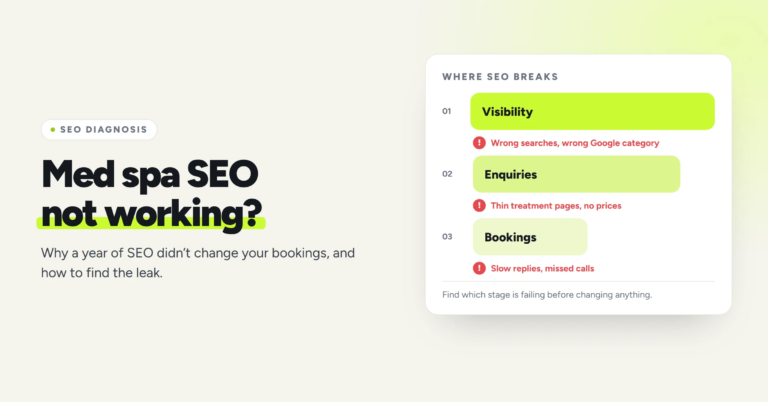
If your med spa marketing isn’t producing more revenue this month than last month, the answer usually isn’t “do more marketing.” One of five things is broken.
Your website doesn’t convert. Your follow-up takes longer than 5 minutes. Your ads spend against the wrong intent. Your reviews aren’t compounding. Or your CRM is a glorified spreadsheet. This guide shows you how to find your bottleneck, then gives you a complete medical spa marketing plan: the strategy, a budget formula, and a 12-month calendar.
The honest scoreboard
I’ll skip the part where most articles tell you “digital marketing is more important than ever.” You already know that. You’re here because something in your funnel isn’t working and you’re trying to figure out which lever to pull.
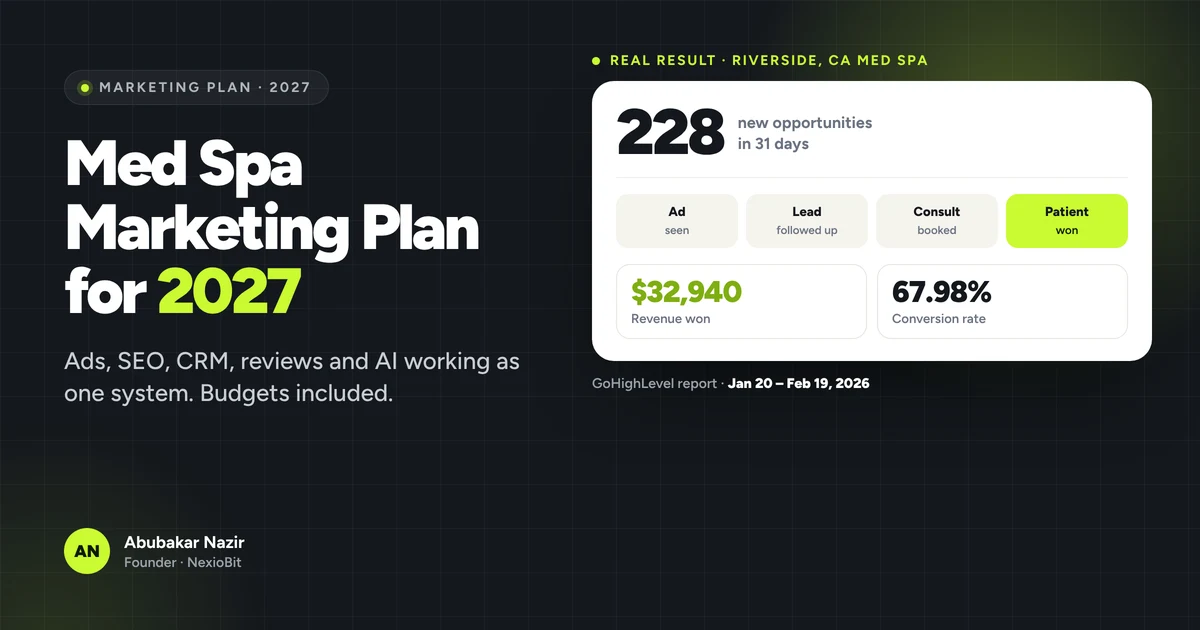
So let me show you what working medical spa marketing looks like, with real numbers from a recent build:
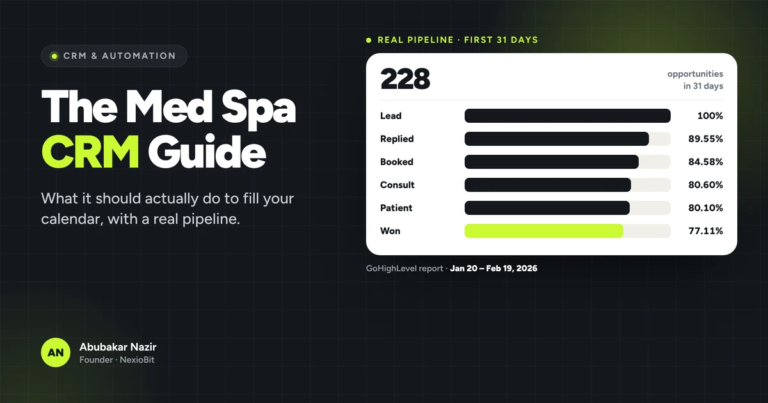
SoCal Slim, Riverside CA: 31 days into the system
That result didn’t come from one tactic. It came from five pieces working together. Most med spas have one or two of those pieces in place, and the missing ones leak patients every day.
The rest of this guide walks through all five, then turns them into a plan.
Why most med spa marketing fails
Most agencies don’t fail med spa clients because they’re bad at Google Ads or SEO. They’re often fine at those individual pieces. They fail because…
A med spa isn’t a marketing problem. It’s an operations problem with a marketing layer on top.
A patient researches your services on Instagram → checks your Google reviews → lands on your website → fills out a form → and then waits three hours for someone to call back. By the time your front desk reaches them, they’ve booked at a competitor.
Your Facebook ad didn’t fail. Your response time failed.
Most med spa digital marketing services miss this because they’re scoped narrowly: “We’ll do your ads” or “We’ll redo your website.” Neither fixes the gap between when a lead arrives and when a human (or AI) responds.
The strategy below treats marketing the way it works going into 2027: one continuous system from “patient sees your ad” to “patient walks in for their second appointment.”
The med spa digital marketing strategies that actually move revenue
If you’re investing in digital marketing for med spa growth this year, these are the five pillars in order of ROI impact. Build them in this order. Don’t skip ahead.
A website that books appointments (not one that “looks nice”)
Your website has one job: turn visitors into booked consults. Everything else is decoration.
In the med spa websites I audit, the same five conversion killers show up almost every time:
The “Book Now” button takes 3 clicks to find
It belongs in your top-right header, on every page, visible without scrolling on mobile. If a patient has to think about how to book, you’ve lost them.
The first thing visitors see is a slideshow of your facility
Your reception area isn’t the value proposition. The result is: a confident person, the treatment they want, the price clarity they expect. Replace stock photography with your real (consented) before/after work and one specific, scannable benefit headline.
Treatment pages bury the answers
A patient researching Botox wants five things first: what it treats, how long it lasts, what it costs, what it feels like, and how to book. Put those at the top of every treatment page. On ad landing pages, stop there, at around 400 words. On treatment pages built to rank in Google, keep going below that with FAQs, candidacy, recovery, and provider credentials. Our med spa SEO guide covers the full treatment page structure.
No price ranges anywhere
Pricing varies by patient, but “starting at $X” or “typically $X–$X” filters out the wrong leads and converts the right ones. Every patient who clicks your ad is wondering about price. Hiding it doesn’t make them call. It makes them check your competitor.
Mobile is broken in subtle ways
Buttons too small to tap. Phone numbers that aren’t clickable. Forms built for a desktop keyboard. Open your site on your phone right now and try to book yourself an appointment. If it takes more than 30 seconds, fix it.
A high-converting med spa site doesn’t need design awards. In the accounts we manage, good sites convert 4–7% of visitors into form submissions or bookings. Below 2%, that’s where your marketing budget is leaking.
Pillar 02Local SEO and Google Business Profile (where most med spa traffic actually comes from)
If you only optimize one thing this quarter, optimize your Google Business Profile.
Most owners think SEO means “rank #1 for botox.” It mostly means showing up in the map pack when someone near you searches “med spa near me” or “Botox near me.” Those searches carry very high intent: people searching on a phone for a nearby clinic are usually ready to call, get directions, or book.
Here’s what actually moves your map pack rankings:
- Choose the right primary category. “Medical spa” as your primary category was the top-scored local pack factor in Whitespark’s 2026 Local Search Ranking Factors survey. Add specific secondary categories that match real treatments.
- Earn a steady flow of detailed reviews. Review recency jumped to #11 among local pack factors in that same survey. A review that describes the treatment and experience does more than a generic “great staff.” See the reviews flywheel below.
- Add every service as a separate entry, with a price range. Most med spas list 3–5 services. You probably perform 25+. Google’s AI features, including Ask Maps (which replaced the old Q&A section), use this information to answer patient questions.
- Post weekly and keep hours exact. Short posts with a photo: treatment of the week, results, an event. “Open at the time of the search” is one of the top five local pack factors, so keep holiday hours updated.
- Add your booking link so patients, and Google’s booking features, can go straight to your calendar.
- Keep NAP consistent. Your business name, address, and phone must be identical on Google, Apple Maps, Yelp, Facebook, Bing, and Healthgrades.
Long-tail content SEO (blog posts ranking for “what to expect after Botox”) is a 6–12 month investment. Google Business Profile improvements can move your phone in 30–60 days. Read our complete medical spa SEO guide, or see how we handle it for clinics on our med spa SEO services page.
Pillar 03Paid ads with realistic expectations (and the CPL ranges nobody tells you)
I’m going to give you the numbers most agencies won’t, because if you don’t know what’s normal, you can’t tell when you’re being overcharged.
Realistic cost-per-lead ranges for US med spas in 2026 (Google Ads + Meta combined, based on what I see across active accounts):
| Treatment | Realistic CPL | What “great” looks like |
|---|---|---|
| Botox / fillers | $35–$80 | Below $40 |
| Weight loss / GLP-1 | $25–$70 | Below $35 |
| CoolSculpting / body contouring | $80–$180 | Below $100 |
| Laser hair removal | $30–$60 | Below $40 |
| Skin tightening (Morpheus, Sofwave) | $90–$200 | Below $120 |
| Microneedling / chemical peels | $25–$55 | Below $35 |
| Hormone replacement | $40–$100 | Below $60 |
Source: NexioBit-managed and audited accounts, 2026. Ranges vary by market size and offer strength.
If your agency shows you $15 cost-per-lead numbers across the board, dig deeper. They’re either counting clicks as leads, buying the cheapest traffic, or running offers so deep they attract people who’ll never become repeat patients.
A few tactical truths about paid ads for med spas going into 2027
- Meta still beats Google for awareness; Google still beats Meta for intent. Run both. The mistake is putting 80% of your budget on one platform because someone “had a bad experience” with the other.
- Treatment-specific landing pages outperform homepages. In our accounts, they convert 3–4x better. If your Botox ad sends traffic to your homepage, you’re paying for clicks that never see the offer they clicked on.
- The deep-discount offer is dying. Big discounts attract one-and-done bargain hunters. Value bundles like a “$199 first-treatment package” tend to bring better lifetime value at a similar response rate.
- Retargeting is where a big share of paid revenue closes. Prioritize people who visited a treatment page but didn’t book. They’re far more likely to convert than cold traffic.
- Compliance is part of the strategy. Meta restricts health and wellness targeting, and the FDA sent another 25 warning letters in June 2026 over misleading claims about compounded GLP-1 drugs. Never imply a compounded medication is FDA-approved or the same as a brand-name drug.
For compliant ad examples, see our Facebook ads playbook for med spas and our med spa advertising service.
Pillar 04CRM and automation (where most med spa revenue is actually being lost)
This is the unglamorous pillar. It’s also where most of your potential revenue leaks.
The Lead Response Management study found leads contacted within 5 minutes were 21x more likely to qualify than leads contacted after 30 minutes. In the practices we audit, response times of several hours are common.
That’s not a marketing problem. It’s an automation problem, and it’s the single highest-impact fix in your entire marketing stack.
The right setup looks like this:
- A real CRM (not a spreadsheet, not your scheduling system). GoHighLevel is what I deploy because it’s HIPAA-configurable under a BAA, has native SMS/voice/email, and integrates with every ad platform. Boulevard, Mindbody, AestheticsPro, and Aesthetic Record are fine for clinical scheduling, but they’re not built for marketing automation. Run them alongside a marketing CRM, not instead of one.
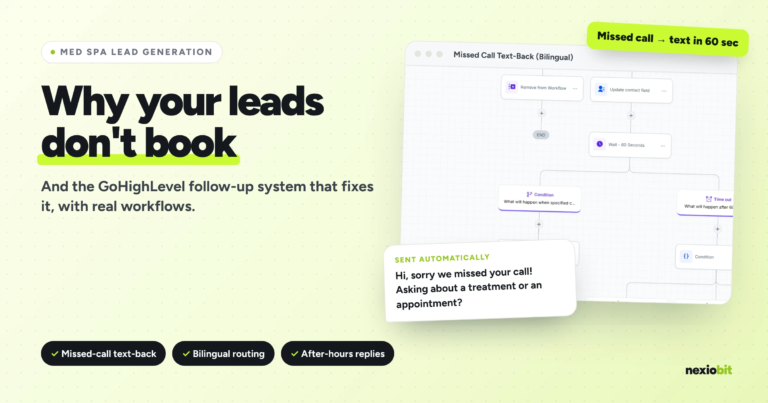
- Automated lead routing within 60 seconds. Form submitted → SMS sent → email sent → task assigned → no response in 5 minutes, escalate to a manager. None of this requires a human. All of it requires setup.
- A 6-stage pipeline for every lead. Lead → Replied → Booked → Consulted → Treated → Won. If you can’t see how many leads sit at each stage today, you’re flying blind.
- Multi-step nurture for non-bookers. A lead who doesn’t book within 48 hours should get a 7-step sequence over 14 days: SMS, email, voicemail drop, retargeting ad. Most med spas send one email and give up. The patient hadn’t decided not to book; they got distracted.
- Appointment reminders and no-show prevention. 24-hour, 2-hour, and 30-minute reminders protect a meaningful share of weekly revenue that would otherwise walk away as no-shows.
With all of this built for SoCal Slim in 31 days, the system produced 228 opportunities and $32,940 in won revenue at a 67.98% conversion rate. That gap between “leads” and “revenue” is where your money is.
AI booking and voice agents (the 2027 edge)
This is the newest pillar and the one most med spa digital marketing companies haven’t caught up to yet. Two applications are mature enough to deploy now:
AI website chat that actually books
Not the “Hello, how can I help you today?” bots from 2020. Current AI booking agents read your treatment menu, answer pricing questions, qualify the lead, and book directly into your calendar, in English or Spanish. For the many website visitors who never fill out a form, a well-configured booking AI gives them a second way in.
AI voice receptionists for inbound calls
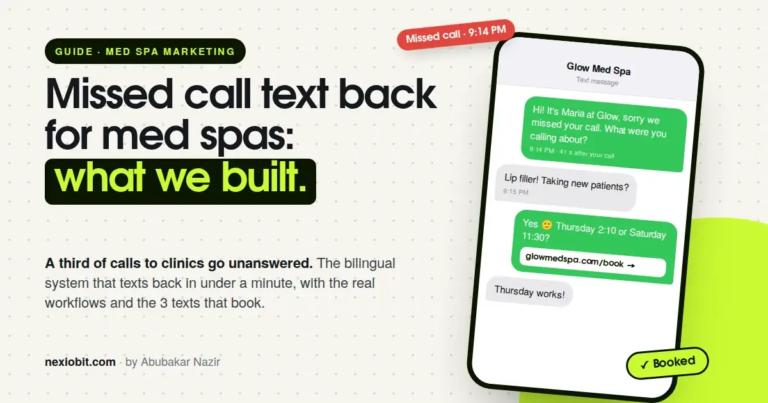
Your front desk steps away for 30 seconds. A patient calls. The patient hangs up and calls the next clinic. A voice AI that answers on ring two, handles basic questions, and books the consult fixes a leak that has quietly cost med spas revenue forever.
It’s also becoming table stakes. At Google I/O in May 2026, Google said its agentic booking features are expanding to beauty services, including AI that can call a business on a searcher’s behalf to check availability. If nobody answers, that booking goes elsewhere.
I deployed an AI voice agent named “Kim” for SoCal Slim. It handles web calls and phone calls, qualifies patients, and books consultations directly, 24/7, including weekends when many med spas miss their highest-intent calls.
See how this works in practice with NexioFront, our AI receptionist for med spas, or compare the options in our AI voice agents guide.
The reviews flywheel (the cheapest growth lever you have)
I’m splitting this out because it underpins all five pillars and most articles bury it.
Reviews make every other channel work harder: higher click-through on ads, better landing page conversion, more map pack visibility, and more favorable AI summaries. Patients are also getting stricter. BrightLocal’s 2026 consumer survey found 31% won’t use a business rated below 4.5 stars (up from 17% the year before), and 74% only trust reviews from the last three months.
Here’s a review automation that works and stays within Google’s rules:
- Patient checks out.
- A few hours later, an automated SMS goes to every patient: “Hi [name], thanks for coming in today. Would you share your experience? [direct Google review link]”
- The same message includes a simple way to reach your team directly if anything wasn’t right.
- If someone raises a problem, a manager calls within 4 hours and fixes it.
- One reminder after 24 hours if they haven’t left a review, then stop.
A consistent system like this can take a med spa from a handful of reviews a month to dozens. It runs on autopilot, costs almost nothing to maintain, and compounds every other dollar you spend. Here’s the review automation system we deploy.
Retention & referral marketing: the half most guides skip
Acquiring a new patient typically costs a med spa $150–$400 all-in in the accounts we see. Getting an existing patient to rebook costs a few dollars in automated texts. Yet most med spas I audit spend almost all of their marketing energy on acquisition and treat retention as “the front desk’s job.”
Four retention systems that outperform any ad campaign on ROI:
Rebooking at checkout
The highest-converting moment in your business is the 90 seconds after a treatment, while the patient is happy and standing at your desk. Ask every patient to book their next visit before they leave. This is a script and a habit, not a technology, and it rebooks far more patients than any follow-up campaign.
Membership programs
A $99–$199/month membership (banked credits, member pricing, a monthly perk) turns unpredictable revenue into a recurring baseline. In the practices we work with, a well-run membership often becomes 20–35% of monthly revenue, and members spend significantly more per year than non-members.
Win-back campaigns
Every med spa has a list of patients who haven’t visited in 4+ months. That list is worth more than any cold audience. A 3-step reactivation sequence (SMS, email, voicemail drop) with a genuine offer routinely reactivates 10–20% of a lapsed list. For 800 lapsed patients, that’s 80–160 appointments from an afternoon of setup.
Referral incentives
Your best patients already talk about you. Give them a reason to do it on purpose: dual-sided rewards ($50 credit for them, $50 for the friend) generally outperform one-sided offers. Put the ask in your post-treatment sequence, not on a forgotten counter card.
All of this runs through the same CRM you built in Pillar 4. The med spas winning in 2027 don’t have separate acquisition and retention strategies. They have one system.
Showing up in AI search (the GEO layer)
A growing share of patients aren’t just Googling “med spa near me.” They’re asking ChatGPT “what’s the best med spa in [city] for Botox?” or reading a Google AI answer that names a few local clinics. BrightLocal’s 2026 survey found 45% of consumers had used an AI tool to find a local business, up from 6% the year before, and Google’s AI Mode passed one billion monthly users.
Getting named there is called GEO (generative engine optimization). AI tools recommend clinics they can verify: complete and consistent business information, a deep base of recent reviews, clear treatment pages with prices, and mentions on sites they trust, like local news and “best med spa in [city]” lists. Since Google replaced Business Profile Q&A with Ask Maps, even questions about your own clinic get answered by AI from those sources.
Almost no med spas are optimizing for this deliberately yet. The full playbook is in our guide to GEO for med spas.
Your 12-month med spa marketing plan
A strategy tells you what matters. A med spa marketing plan tells you what to do, in what order, with what budget, and how you’ll know it’s working. Here’s the three-step version we use with clients.
Step 1: Pick one number to track per pillar
If you can’t measure it monthly, it isn’t part of the plan.
| Pillar | Number to track | Healthy target |
|---|---|---|
| Website | Visitor-to-lead conversion rate | 4–7% |
| Local SEO / GBP | Calls + booking clicks from your Google listing | Rising month over month |
| Paid ads | Cost per booked consultation | Within your CPL range above |
| CRM + automation | Speed to first response | Under 5 minutes, 24/7 |
| Reviews | New Google reviews per month | 15+ at 4.6 stars or higher |
| Retention | Rebook rate at checkout | Most patients leave booked |
Step 2: Set your budget
As a general benchmark, most med spa owners invest around 7–10% of monthly revenue in marketing, including ad spend. A practice doing $100,000 a month would budget roughly $7,000–$10,000. New practices and those opening a second location often spend more in year one to build momentum. The cost breakdown below shows where that money typically goes.
Step 3: Follow a quarterly calendar
Med spa demand is seasonal. Build the foundation when it’s quiet and push spend when patients are already looking.
| Quarter | Focus | Campaign ideas |
|---|---|---|
| Q1 (Jan–Mar) | Fix the foundation: tracking, CRM follow-up, website conversion, Google Business Profile | January is often slow, so run a win-back campaign to lapsed patients and launch or refresh your membership |
| Q2 (Apr–Jun) | Scale paid ads once follow-up is fast; review engine running | Body contouring and skin before summer; wedding season packages |
| Q3 (Jul–Sep) | Retention and content during the late-summer dip; build SEO pages | Patient referral push; start laser hair removal promotions in September, since treatment works best away from summer sun |
| Q4 (Oct–Dec) | Highest-intent season for injectables; protect your calendar | Pre-holiday Botox and filler bookings, gift cards, annual membership offers; plan next year’s budget |
- Goal: new patients per month and monthly revenue target
- Bottleneck: the one pillar you’re fixing first (see “Where to start”)
- Budget: monthly total and split by channel
- Top 3 treatments to promote this quarter
- 6 numbers from Step 1, reviewed on the same day every month
- Owner: one named person accountable for each number
A plan that fits on one page and gets reviewed monthly beats a 40-page strategy deck every time.
Your 2027 med spa marketing checklist
January is when patients book the treatments they promised themselves over the holidays. Med spas that fix these eight things in December catch that wave. The ones that wait spend Q1 paying for leads that leak.
- Test your own lead form tonight. Fill it in at 9 PM and time how long the first reply takes. If it’s more than five minutes, fix that before you spend another dollar on ads.
- Cover after-hours calls. Decide who or what answers the phone after 6 PM and on weekends. Missed calls are the most expensive leak in this guide.
- Point every Book button at your real calendar. On Google, Instagram, and your website. Not the homepage, not a contact form.
- Check your Google Business Profile. “Medical spa” as the primary category, every treatment listed with a price range, fresh photos, and your booking link.
- Turn on a steady review flow. A request after every visit, and a reply to every review within a day, without confirming anyone was a patient.
- Build a January reactivation list. Patients who haven’t booked in 90+ days. A short, personal text in the first week of January beats any new-patient ad.
- Reread your weight loss and GLP-1 copy. Have your medical director check every claim on your site and in your ads before you scale spend.
- Ask ChatGPT and Google’s AI who the best med spa in your city is. Write down who gets named. Check again every month.
None of these need a new agency or a bigger budget. They need one afternoon and one person who owns the list.
What med spa marketing actually costs in 2027
Most agencies dance around this question. I won’t.
For a single-location med spa doing $80K–$150K/month in revenue, here are realistic monthly investment ranges:
| Component | Monthly investment |
|---|---|
| Paid ads (Google + Meta) | $3,000–$8,000 |
| Agency management of ads | $1,500–$3,500 |
| SEO + content | $1,000–$3,000 |
| CRM platform (e.g., GoHighLevel) | $97–$497 |
| CRM build + management | $1,500–$3,500 |
| Website rebuild (one-time, amortized) | $300–$700/mo equiv |
| Reviews automation tool | $99–$397 |
| AI booking / voice agents | $200–$800 |
- Floor for a real attempt: ~$4,000–$5,000/month including ad spend.
- Where most growing med spas land: $8,000–$15,000/month, in line with the 7–10% of revenue benchmark.
- Diminishing returns: above roughly $25,000/month for a single location.
If an agency quotes $799/month all-in for “complete digital marketing,” they’re either selling templated work that won’t move your numbers or hiding the ad spend you’ll be billed separately.
The five mistakes I see most med spas make
1. Hiring a generalist agency
An agency that handles dentists, plumbers, and med spas won’t beat one that runs only med spa accounts. Vertical expertise compounds: ad copy that respects FDA and Meta rules, before/after compliance, treatment-specific landing pages, HIPAA-aware automation.
2. Optimizing one channel in isolation
“We need better Facebook ads” usually isn’t the problem. The website those ads point to converting at 1.4% is. Fixing ads without fixing the funnel is rearranging deck chairs.
3. Cutting marketing in slow months
Demand dips in January and August, but practices that keep their engine warm capture patients while competitors go dark. Cut spend in slow months and you’ll be rebuilding momentum every spring. Shift the focus to retention instead of switching off.
4. Treating reviews as a “nice to have”
Reviews multiply every other marketing dollar. With nearly a third of consumers now skipping businesses under 4.5 stars, they’re also a filter you can’t afford to fail.
5. Not measuring lead source
If you can’t say what share of last month’s revenue came from Google Ads vs. Meta vs. organic vs. referrals, you can’t make an intelligent budget decision. Set up source tracking before you increase spend by another dollar.
How to choose a med spa marketing agency
If you’re hiring an agency rather than building this in-house, ask these questions before you sign:
- “Show me a recent 30-day report from a real med spa client.” Not a case study deck. The actual report: real CPL, real lead volume, real conversion rate.
- “Who manages my account day-to-day?” The right answer is a named person you’ll talk to weekly, not a junior you meet after signing.
- “What’s your contract length?” Long lock-ins for a new relationship are a red flag. Good agencies earn renewals on results.
- “How do you handle HIPAA?” A real answer involves a signed Business Associate Agreement, configured platforms, and explicit data handling protocols.
- “What happens at offboarding?” You should own your ad accounts, CRM, domain, and content.
We wrote a full checklist: how to choose a med spa marketing agency, with seven questions to ask before you sign. To see how we work, here’s our approach as a med spa marketing agency.
Where to start if you’re feeling overwhelmed
The first move isn’t to “fix everything.” It’s to identify your single biggest bottleneck. Pick the statement that best describes your practice today:
- “We get plenty of leads, but they don’t book.”Your bottleneck is Pillar 4 (CRM + automation). Start there.
- “We barely get any leads.”Your bottleneck is Pillars 2 + 3 (SEO + paid ads). Audit your Google Business Profile first, then your ads.
- “Our website looks dated and we’re embarrassed by it.”Start with Pillar 1 (website), but don’t stop there.
- “Our reviews are below 4.5 stars.”The reviews flywheel is your highest-impact fix. Everything else gets harder until this is addressed.
- “We’re missing calls and the front desk is overwhelmed.”Pillar 5 (AI receptionist) can solve this in about a week.
Fix that one thing first, then work through the 12-month plan above. Sequence wins.
The questions med spa owners actually ask me.
Direct answers to the questions I get most on discovery calls and audits.
What should a med spa marketing plan include?
A complete med spa marketing plan covers five connected pillars: a website that books appointments, local SEO with a fully optimized Google Business Profile, paid ads with realistic cost-per-lead targets, a CRM that follows up on every lead within minutes, and AI booking for after-hours inquiries. A reviews engine and a retention program sit underneath all five. On top of that, the plan needs one number to track per pillar, a monthly budget, and a quarterly calendar that follows your seasonal demand.
How much should a med spa spend on marketing?
As a general benchmark, most med spa owners invest around 7–10% of monthly revenue in marketing, including ad spend. For a practice doing $100,000 a month, that’s roughly $7,000–$10,000. New practices and those opening a second location often spend more in their first year. The floor for a real attempt is about $4,000–$5,000 a month including ads.
How much does med spa digital marketing cost?
For a single-location med spa doing $80K–$150K/month in revenue, realistic monthly investment lands between $4,000 and $15,000 all-in, including ad spend, agency management, CRM fees, SEO, reviews automation, and optionally AI booking agents. Most growing med spas land at $8,000–$15,000. Diminishing returns kick in above roughly $25,000/month for a single location. A $799/month “complete digital marketing” quote usually means templated work or hidden ad spend.
What are the best med spa marketing strategies in 2027?
In order of ROI impact: (1) a website that converts 4–7% of visitors, (2) local SEO and a fully optimized Google Business Profile, (3) Google and Meta ads with realistic CPL targets ($35–$80 for Botox, $25–$70 for weight loss), (4) a real CRM with automated lead follow-up in under 5 minutes, where most med spa revenue leaks, and (5) AI booking and voice agents for 24/7 capture. Reviews, retention, and visibility in AI search run underneath all five.
How long does it take to see results from med spa marketing?
Different channels move on different timelines. Paid ads can produce booked consults within 7–14 days of launch. CRM automation shows measurable conversion lift within 30 days; one recent client build produced $32,940 in won revenue in its first 31 days. Google Business Profile optimization typically moves map pack rankings in 30–90 days. Content SEO is a 6–12 month investment. If an agency promises page-one organic rankings in 30 days, walk away.
Should I hire a med spa marketing agency or build it in-house?
Hire an agency if you don’t have someone who has personally run Google Ads, Meta Ads, a CRM, and an SEO program for a med spa. Build in-house if you do. Hiring one junior coordinator to do everything almost always loses. A specialist agency typically charges $1,500–$3,500 per channel in management fees on top of ad spend. Whichever you choose, avoid generalist agencies that serve dentists, plumbers, and med spas alike. Vertical expertise compounds.
What’s different about med spa marketing compared to regular marketing?
Three things. First, regulatory guardrails: FDA and FTC rules on treatment claims, testimonials, and before/after photos, plus Meta’s health ad restrictions and the FDA’s 2025–2026 crackdown on compounded GLP-1 marketing. Second, HIPAA: any system that touches patient data needs a Business Associate Agreement and properly configured tools, and it even affects how you reply to reviews. Third, treatment-specific buyer psychology: someone shopping for Botox researches differently than someone considering CoolSculpting or weight loss.
How do I create a med spa marketing plan?
Sequence, don’t sprawl. Score yourself against the five pillars and fix your single biggest bottleneck first. For most practices that’s follow-up speed, not ads. Then pick one number to track per pillar, set a budget around 7–10% of monthly revenue, and map campaigns to a quarterly calendar: foundation and win-backs in Q1, scaled ads in Q2, retention and SEO in Q3, and injectables and gift cards in Q4. Review the numbers on the same day every month.
Abubakar Nazir
Founder & Principal · NexioBit
I run NexioBit, an AI-powered marketing agency that works exclusively with US medical spas. Everything in this guide reflects what I actually do for clients. If you want a second opinion on your funnel, book a free 30-minute call and I’ll send you a written audit with the 15 to 30 highest-impact fixes within 7 days, including whether you need an agency at all.
More about NexioBitWant a free audit of your med spa funnel?
30 minutes, no sales rep, no slides. I’ll review your website, ads, follow-up, and reviews, then send a written audit with the 15–30 highest-impact fixes within 7 days. Yours to keep, whether you hire us or not.
Book my free audit