Facebook Ads for Med Spas: The Playbook That Doesn’t Get Rejected
The complete guide to Facebook ads for med spas: run Facebook and Instagram campaigns inside Meta’s health policies and HIPAA. Rejection fixes, compliant ad rewrites, cost benchmarks by treatment, and a calculator for your true cost per booked patient.
Why Facebook ads still work for med spas (and why most fail)
Aesthetic treatments are visual, personal and often decided on impulse. Very few people wake up and search “neurotoxin near me” out of nowhere; they see a provider they trust, a friend’s result, or a well-timed offer, and decide it’s time. Meta is built for that kind of demand, which is why Facebook ads for med spas remain the highest-volume paid channel for most practices in 2026.
Google Search captures people already looking. Meta reaches the much larger group who would book if the right offer found them. So why do so many owners give up? In the accounts we audit, it comes down to four problems:
Rejections & restricted accounts
Ads written like a skincare brand trip Meta’s health and personal-attribute rules.
“We do everything” campaigns
One generic ad gives Meta no clear offer, audience or signal.
Leads that go cold
A 9:40 PM lead called back at noon has usually booked elsewhere.
Measuring the wrong number
The cheapest leads often never become paying patients.
This guide fixes all four, starting with the one that stops everything else: getting ads approved and keeping your account healthy. It’s one part of our wider med spa digital marketing playbook.
Meta’s rules for med spa ads in 2026
If you’re asking how to advertise a med spa on Meta legally, there are two layers: Meta’s advertising standards (whether your ad runs) and state and federal rules (whether you can say it at all). Meta’s enforcement is partly automated and changes often, so treat these as how the rules behave in real accounts, and check Meta’s current Advertising Standards before launching a new treatment.
Age: 18+ only
Cosmetic procedure ads must be restricted to adults.
No personal attributes
Ads can’t imply the viewer has a condition: “Are your wrinkles aging you?”
No negative self-image
Copy or images that make people feel bad about how they look get rejected.
Before & afters
Side-by-side transformations are frequently rejected, and landing pages are reviewed too.
No body close-ups
Images zooming in on or pinching a body area are commonly flagged.
Prescription drugs
Rx products (neurotoxins, GLP-1s) generally need LegitScript. Brand-name enforcement is inconsistent.
No unrealistic claims
Guarantees, “painless”, or weight-loss numbers in a timeframe get rejected.
No graphic imagery
Needles in skin, blood or open treatment areas are restricted.
Landing page must match
Meta reviews the destination, not just the ad.
State rules sit on top of Meta’s. Many states regulate how medical services, providers and discounts can be advertised. The American Med Spa Association (AmSpa) and your state medical board are the right places to check. This guide is marketing guidance, not legal advice.
HIPAA-compliant Facebook ads: pixel, CAPI, forms and audiences
Most advice on HIPAA compliant Facebook ads focuses on copy. The bigger risk for a med spa is data: what your tracking sends back to Meta. Meta won’t sign a Business Associate Agreement, so nothing that could count as protected health information should reach it. Federal regulators (HHS) have warned healthcare providers about tracking pixels on pages where patients share health information, and since 2025 Meta itself has been limiting the data health and wellness advertisers can send. Here’s the flow we set up:
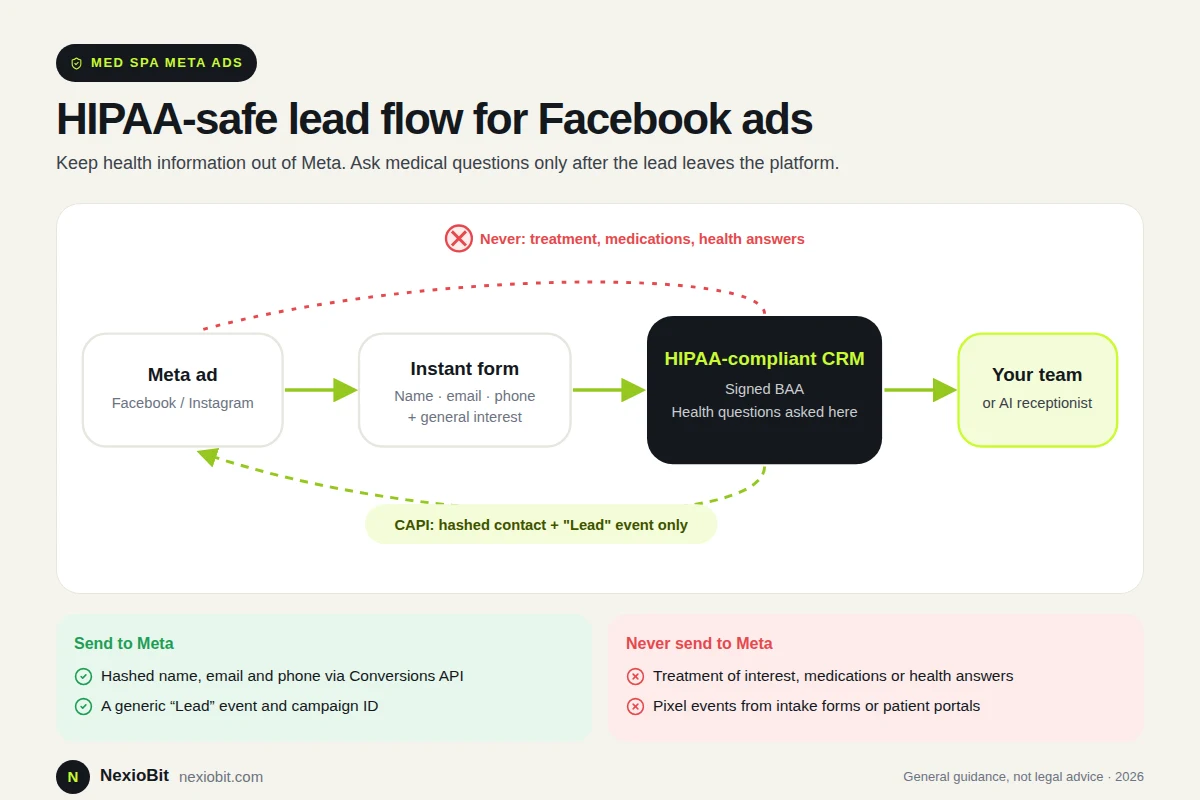
Do
- Pixel on public pages: homepage, treatment pages, ad landing pages
- Conversions API sends a “Lead” event with hashed name, email, phone
- Instant forms ask contact details + a general interest
- Neutral URLs like
/offer-a/and generic event names - Lookalikes seeded from lead-form submitters
Don’t
- Pixel on intake forms, questionnaires or patient portals
- Treatment, medication or health answers as event parameters
- Medical questions (pregnancy, conditions) inside Meta forms
- URLs like
/weight-loss-intake-thank-you/ - Uploading treatment-segmented patient lists to Meta
If you run GoHighLevel, that means a HIPAA-enabled sub-account with a signed BAA. We walk through it in our GoHighLevel for med spas guide.
Why do my Facebook ads keep getting rejected? The troubleshooter
Meta’s rejection notice names a broad policy (“Health and wellness”, “Personal attributes”) without saying which word or image caused it. Search your rejection reason or filter by type to find the fix.
Personal attributes
Negative self-perception
Unrealistic results
Prescription drugs
Prescription drugs
Body focus
Graphic content
Negative self-perception
Misleading claims
Age restriction
Destination review
Misleading / state rules
Sensitive targeting
Account trust
Account enforcement
Rejected ad, now what? Don’t delete and relaunch the same creative with small edits; every rejection counts against your account. Request a review once if you believe it’s wrong, otherwise fix the root cause and submit a clean new ad.
Compliant ad rewrites you can adapt
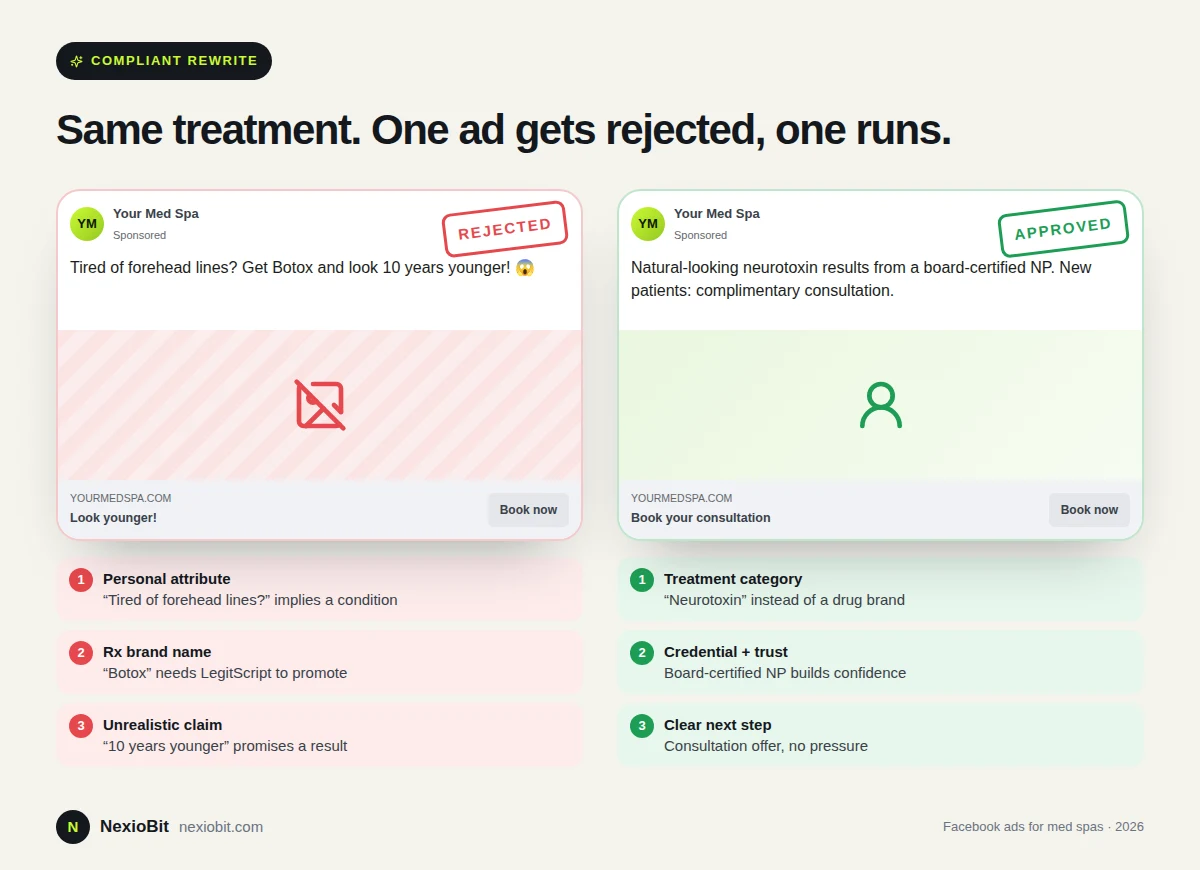
These are the patterns we see rejected most often in med spa accounts, from Botox Facebook ads to weight loss offers, next to versions that stay inside the rules. Swap in your city and details, and review each against your state’s advertising rules before launching.
Which treatments to advertise on Facebook
Not every service suits Meta. The best performers have broad appeal, a low first-visit price, and a result people understand without much education.
Lead with
Proven Meta performers
Test carefully
Can work with the right offer
Send to Google
Better from search intent
Campaign structure: the three-tier setup
Most med spas either run one ad to everyone or split a small budget across thirty ad sets. Neither gives Meta enough signal. Three tiers mirror how patients actually decide:
New people in your area. Objective: Leads. One ad set per treatment, 3–5 creatives each, broad targeting, Campaign Budget Optimization.
Site visitors, Instagram engagers and video viewers who didn’t book. Reviews, provider intros, social proof.
Past leads who never booked and lapsed patients. New treatments, seasonal offers, memberships.
Keep retargeting in its own campaign so it isn’t starved by the larger prospecting budget.
Targeting that stays inside the rules
Meta removed most of the health-related interest targeting med spas used to rely on, and in 2026 broad targeting with strong creative usually wins anyway.
- Location: a 10–25 mile radius. Tighter in dense metros, wider in suburbs.
- Age: 18+ is required for cosmetic procedures. Most practices use 25–65.
- Gender: mostly women, but test all genders for neurotoxin and weight loss.
- Interests: keep them broad (Beauty, Skin care) or leave them off.
- Lookalikes: seed from lead-form submitters, not treatment-specific patient lists.
- Advantage+ audience: test once your Pixel and CAPI data are clean.
Aim for a prospecting audience of several hundred thousand people. Creative does the real targeting: a lip filler video self-selects people interested in lip filler.
Creative that converts (and passes review)
Creative is the biggest lever in med spa Facebook ads. The same audience can produce very different costs per lead depending on the image, the first three seconds of video, and the first line of copy.
Provider-to-camera video
Your injector explaining a first appointment. Builds trust fast and stays compliant.
UGC patient stories
Phone-filmed, with written consent. Usually beats polished studio video.
Bold offer graphics
Treatment, offer and provider photo, readable even when blurred.
Carousels
One card per treatment, or “what to expect” step by step.
Vertical Reels
A big share of impressions now come from Reels, which needs 9:16 video.
Fresh every 3–6 weeks
Refresh when frequency passes 3 and cost per lead starts climbing.
Anatomy of a compliant med spa ad
- 1Hook
Treatment, offer and location in the first line. Meta truncates after about 125 characters.
- 2Context
Who performs it, how long it takes, what it feels like.
- 3Proof
Reviews, credentials, years in practice.
- 4Next step
Tell people exactly what happens after they tap.
Instant forms vs landing pages
Meta instant forms
Best for: neurotoxin, lip filler, facials and entry offers. Use the “Higher intent” form plus 2–3 questions: service of interest, timeline, preferred contact time.
Landing page
Best for: $3,000+ packages, body contouring and weight loss programs. Under 2 seconds on mobile, one CTA, same imagery as the ad, Pixel off the form step.
Most med spas should start with instant forms and add qualifying questions before blaming the form type for lead quality. Either way, the lead needs an instant hand-off to a person or system that responds within minutes.
How much to spend on Facebook ads for a med spa
1–2 treatment campaigns for a solo injector or single location.
3–4 treatment campaigns plus retargeting.
Full menu, retargeting and re-engagement across providers or locations.
Is $10 a day enough for Facebook ads? For a med spa, usually not. It produces too few conversions for Meta to optimise. Around $50 a day (about $1,500/month) on one focused treatment is a realistic minimum to learn whether an offer works.
How much do med spas spend on advertising overall? It varies by market and growth stage. Most established practices set a share of revenue for marketing and split paid spend between Meta (demand creation) and Google Search (high-intent capture). Management fees are separate from ad spend; our med spa ad management pricing is published if you want a reference point.
Cost per lead benchmarks by treatment (2026)
These ranges reflect benchmarks commonly published by med spa advertising agencies for US markets in 2025–2026. Use them to spot outliers, not as targets. Your offer, city and follow-up speed matter more.
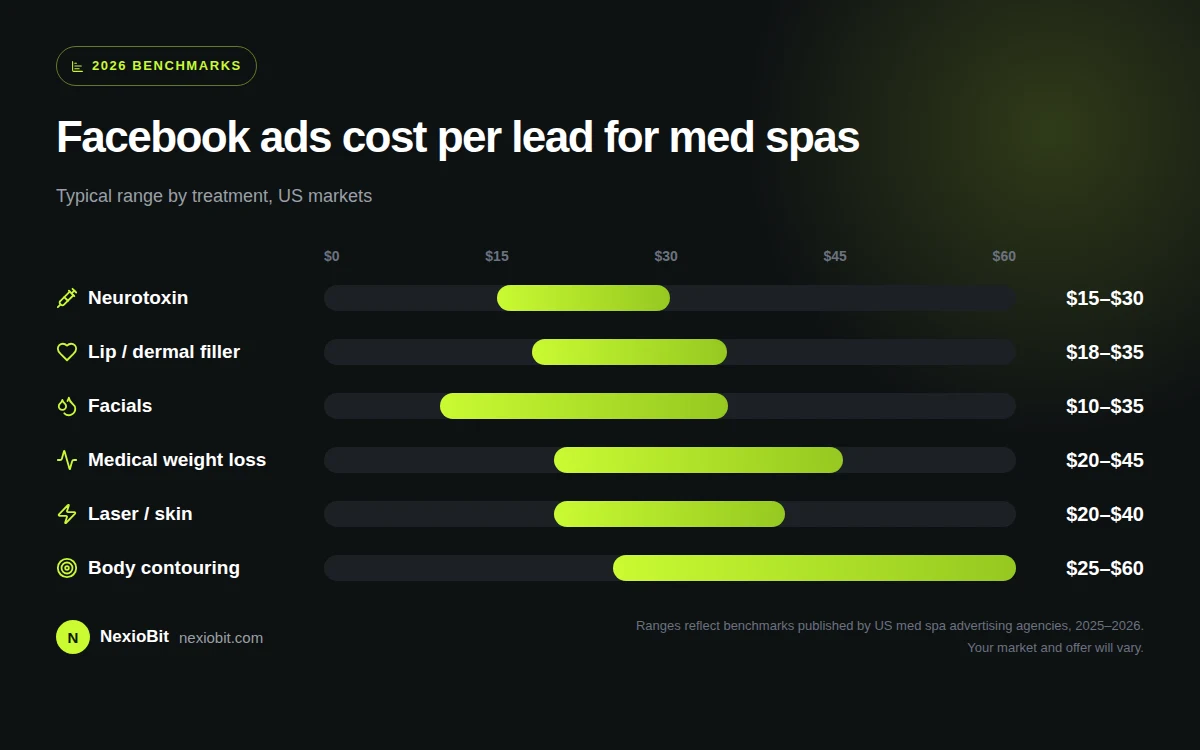
At a glance: neurotoxin $15–$30, lip and dermal filler $18–$35, facials $10–$35, medical weight loss $20–$45, laser and skin treatments $20–$40, and body contouring $25–$60 per lead. Neurotoxin leads are the most valuable over 12 months because patients return every 3–4 months.
Cost per lead only tells you what the top of the funnel costs. The number that decides profitability is next.
Calculator: your true cost per booked patient
Enter your own numbers to see what one new paying patient actually costs from Facebook ads, and which stage of your funnel is losing the most.
Cost per booked patient
Defaults are illustrative. Replace them with your ad account and CRM numbers.
Notice how much the booking percentage moves the result. Raising it from 30% to 45% usually does more for profit than halving cost per lead, and that’s a follow-up problem, not an ads problem.
Where med spa ad budget leaks after the click
In the accounts we review, the ads are rarely the biggest problem. The leaks happen between “lead submitted” and “patient in the chair”:
9:40 PM on a Tuesday. Many Meta leads arrive in the evening when the front desk has gone home.
Leads contacted within minutes book at far higher rates than leads called the next day.
An AI receptionist that answers and books around the clock closes the gap. NexioFront →
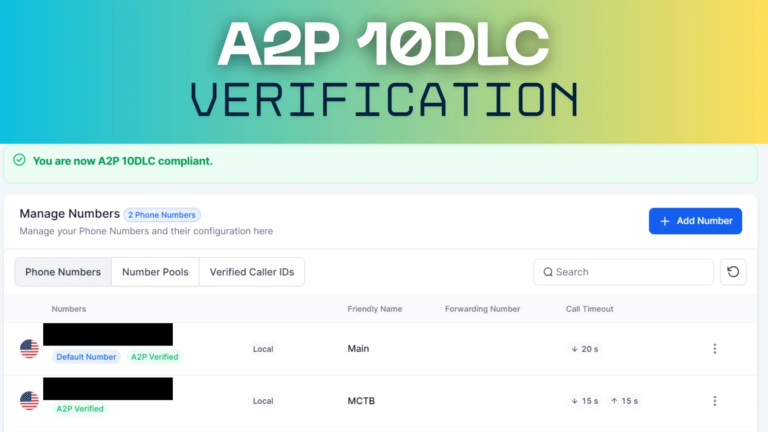
Unregistered business numbers get filtered by carriers. Register for A2P 10DLC first. 10DLC guide →
A four-second mobile load loses the lead before the page renders. Website design →
Without booked-patient data flowing back, Meta optimises for form-fillers. Upload offline conversions weekly, without health data.
What happens when the funnel after the click is fixed
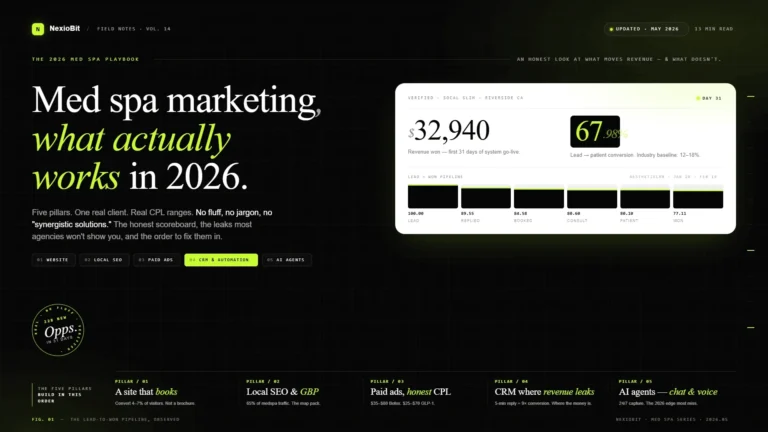
SoCal Slim had no reliable follow-up system. We built the full stack: GoHighLevel CRM, a conversion-focused landing page, treatment-specific paid campaigns, and NexioFront answering every lead. These are system results from the first 31 days, with paid ads as a traffic source rather than ads alone.
DIY or hire a med spa Facebook ads agency?
Running Meta ads yourself is realistic with a few hours a week, one location, and someone who enjoys testing creative. Consider hiring out when you see these signs:
Account restricted
Rejections are eating your week or the account is limited.
$3K+ spend, no clarity
You can’t say what one booked patient costs.
Leads outpace your team
Leads arrive but nobody books them fast enough.
Two channels, one view
You want Google and Meta managed with one attribution report.
When you evaluate a med spa Facebook ads management partner, ask three questions. The answers separate specialists from generalists quickly:
Want a second opinion on your Meta account?We’ll review your ads, rejection history and lead follow-up, and show you where budget is leaking. Free, 30 minutes.
Book a free ads auditFacebook ads for med spas: FAQ
Why is Meta rejecting my ads for my med spa?
Most med spa rejections come from copy that implies something about the viewer (“Tired of your wrinkles?”), side-by-side before-and-after images, specific weight-loss claims, named prescription drugs like Botox or semaglutide, body close-ups, or a landing page that breaks the same rules. The troubleshooter in section 4 matches each rejection reason to a fix.
How do I fix rejected ads on Facebook?
Open the rejected ad in Ads Manager or Account Quality to see which policy was flagged. If you believe the decision is wrong, request a review once. Otherwise, fix the root cause (the wording, image or landing page) and submit a new, clean ad. Avoid repeatedly editing and resubmitting the same rejected ad, because repeated rejections can lead to account restrictions.
How do I advertise my med spa on Meta legally?
Follow Meta’s Advertising Standards (target people 18 and older, no personal-attribute language, no misleading or guaranteed results, no graphic imagery) and your state’s rules for advertising medical services, providers and discounts. AmSpa and your state medical board are the best sources for state-specific rules. For anything that affects your license, confirm with a healthcare attorney.
How can I advertise Botox on Facebook?
Botox is a prescription drug, and Meta generally requires LegitScript certification to promote prescription medications, although enforcement on the brand name is inconsistent. The safe approach is to advertise the treatment category (“neurotoxin” or “wrinkle relaxer”), lead with your provider’s credentials and a consultation offer, and name the brand on your landing page instead of in the ad.
What are the HIPAA restrictions on Meta ads for medical spas?
The main HIPAA risk is data, not ad copy. Meta won’t sign a Business Associate Agreement, so health information should never reach it. Keep the Meta Pixel off intake forms and patient portals, send only hashed contact details through Conversions API, ask medical questions only after the lead is in your HIPAA-compliant CRM, and don’t upload treatment-specific patient lists.
Is $10 a day enough for Facebook ads?
For a med spa, usually not. At $10 a day you’ll get only a handful of leads a month, which isn’t enough data for Meta’s algorithm to optimise. Around $50 a day (about $1,500 a month) on one focused treatment campaign is a more realistic minimum to learn whether an offer works.
How much do med spas spend on advertising?
It varies by market and growth stage. Most single-location med spas spend roughly $1,500 to $5,000 a month on Meta ads alone, plus Google Ads and any agency management fee. Established practices usually set marketing as a share of revenue and split paid spend between Meta for new demand and Google Search for high-intent patients.
How much do Facebook ads cost per 1,000 views?
Cost per 1,000 impressions (CPM) changes with location, season and competition. For local health and beauty audiences in the US, CPMs are commonly reported somewhere in the $10 to $30 range, often rising in Q4. For a med spa, CPM matters less than cost per lead and cost per booked patient, which you can estimate with the calculator in section 13.
Do Meta lead forms or landing pages convert better for med spas?
Lead forms usually produce more leads at a lower cost; landing pages usually produce fewer, higher-intent leads. For neurotoxin, lip filler and facials, start with Meta’s “Higher intent” lead form plus 2–3 qualifying questions. Use a fast landing page for high-ticket packages like body contouring or weight loss programs that need more explanation.
How do I get clients for my med spa on Facebook?
Run one campaign per treatment with a clear new-patient offer, target adults within 10–25 miles, use provider video and compliant copy, and retarget people who visited your site but didn’t book. Then respond to every lead within minutes, including after hours. Most lost clients are lost in follow-up, not in the ad itself.
Who manages Facebook and Instagram advertising for med spas?
Options include doing it in-house, hiring a freelancer, or using a med spa marketing agency. A specialist agency is worth considering once you’re spending $3,000+ a month, dealing with rejections, or can’t measure cost per booked patient. Ask any provider how they keep your account compliant, whether they report cost per booked patient, and who handles leads after they come in.
This guide is general marketing information, not legal advice. Meta’s advertising policies and US healthcare privacy rules change; check Meta’s current Advertising Standards and consult qualified counsel for decisions about your practice. Brand names are trademarks of their respective owners.
Stop losing budget to rejections and slow follow-up
NexioBit runs compliant Google and Meta ads for med spas, with landing pages, CRM and AI booking built by the same team, so you can see your real cost per booked patient.